Chebyshev Type I Filter Theory
Chebyshev Polynomials and Elliptical Pole Locations
This article presents the mathematical foundations of the Chebyshev filter. We begin with the definition and properties of Chebyshev polynomials, derive the amplitude-squared response, and then obtain the elliptical pole locations.
The Prototype Lowpass Filter Concept
Filter design begins by designing a prototype lowpass filter with cutoff angular frequency $\omega_c = 1$.
Suppose there exists a function $f(\omega)$ that is small for $\omega$ in the range from $0$ to $1$ and increases rapidly for $\omega > 1$.
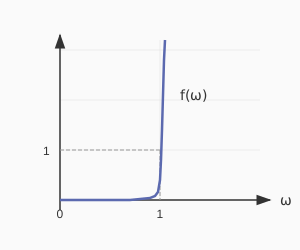
Using this $f(\omega)$, we construct
$$ g(\omega) = \frac{1}{1 + f(\omega)} $$which yields a lowpass filter amplitude response.
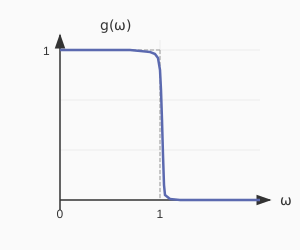
Chebyshev Polynomials
The Chebyshev filter uses the square of the Chebyshev polynomial of the first kind $T_n(\omega)$ as $f(\omega)$.
$T_n(\omega)$ is defined by the following recurrence relation:
\begin{align} T_0(\omega) &= 1 \\ T_1(\omega) &= \omega \\ T_{n+1}(\omega) &= 2\omega T_n(\omega) - T_{n-1}(\omega) \end{align}The first several Chebyshev polynomials are listed below:
| $n$ | $T_n(\omega)$ |
|---|---|
| 0 | $1$ |
| 1 | $\omega$ |
| 2 | $2\omega^2 - 1$ |
| 3 | $4\omega^3 - 3\omega$ |
| 4 | $8\omega^4 - 8\omega^2 + 1$ |
| 5 | $16\omega^5 - 20\omega^3 + 5\omega$ |
| 6 | $32\omega^6 - 48\omega^4 + 18\omega^2 - 1$ |
Closed-Form Expressions
Although $T_n(\omega)$ defined by the recurrence is a polynomial of degree $n$ in $\omega$, it can be written in closed form using trigonometric or hyperbolic functions depending on the range of $\omega$:
\begin{equation} T_n(\omega) = \cos(n \cos^{-1} \omega) \quad (|\omega| \leq 1) \label{eq:trig} \end{equation} \begin{equation} T_n(\omega) = \cosh(n \cosh^{-1} \omega) \quad (|\omega| > 1) \label{eq:hyp} \end{equation}These are different representations of the same polynomial. At $\omega = 1$, $\cos^{-1}1 = \cosh^{-1}1 = 0$, so both give $T_n(1) = 1$.
$n=1$: $T_1 = \omega = \cos\theta = \cos(1 \cdot \theta)$ ✓
From the recurrence, $T_{n+1} = 2\cos\theta \cdot T_n - T_{n-1}$. Assuming $T_n = \cos(n\theta)$, the addition formula gives $$2\cos\theta\cos(n\theta) = \cos((n+1)\theta) + \cos((n-1)\theta)$$ Therefore $T_{n+1} = \cos((n+1)\theta)$ is proved by induction. That is, for all $n \geq 0$, \begin{equation} T_n(\cos\theta) = \cos(n\theta) \label{eq:Tn-cos} \end{equation} holds. Substituting $\theta = \cos^{-1}\omega$ from $\omega = \cos\theta$ yields Eq.\eqref{eq:trig}.
$n=1$: $T_1 = \omega = \cosh\alpha$ ✓
From the recurrence, $T_{n+1} = 2\cosh\alpha \cdot T_n - T_{n-1}$. Assuming $T_n = \cosh(n\alpha)$, the addition formula for $\cosh$ gives $$2\cosh\alpha\cosh(n\alpha) = \cosh((n+1)\alpha) + \cosh((n-1)\alpha)$$ Therefore $T_{n+1} = \cosh((n+1)\alpha)$ is proved by induction. Since the recurrence is the same, Eq.\eqref{eq:trig} and Eq.\eqref{eq:hyp} define the same polynomial.
Domain of $\cosh^{-1}\omega$: $\cosh^{-1}\omega$ is a real-valued function defined for $\omega \geq 1$ ($\cosh^{-1}\omega = \ln(\omega + \sqrt{\omega^2 - 1})$). Eq.\eqref{eq:hyp} is used to evaluate $T_n$ for $|\omega| > 1$.
On the other hand, the pole derivation (below) does not use Eq.\eqref{eq:hyp} but rather extends the identity $T_n(\cos\theta) = \cos(n\theta)$ (Eq.\eqref{eq:Tn-cos}) to complex $\theta$, so the domain restriction of $\cosh^{-1}$ does not arise.
Properties of Chebyshev Polynomials
- For $|\omega| \leq 1$, $|T_n(\omega)| \leq 1$ (oscillates between $-1$ and $1$)
- For $|\omega| > 1$, $|T_n(\omega)|$ grows rapidly
- $T_n(1) = 1$ (for all $n$)
- The leading coefficient is $2^{n-1}$ (for $n \geq 1$)
- $T_n(-\omega) = (-1)^n T_n(\omega)$ (parity property)
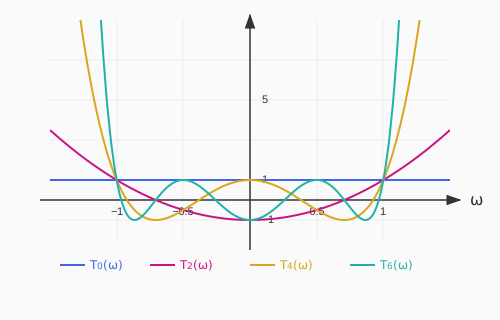
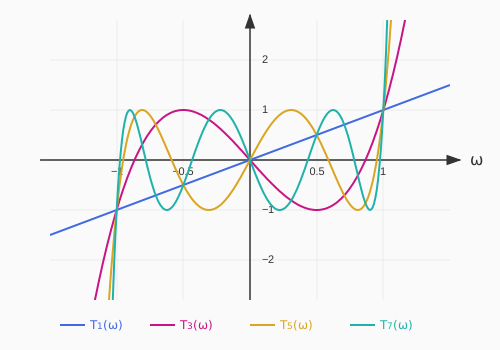
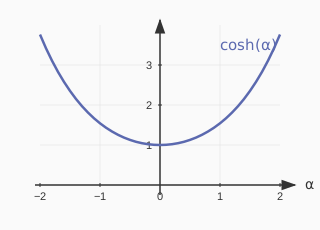
For $|\omega| > 1$, Eq.\eqref{eq:hyp} gives $T_n(\omega) = \cosh(n\cosh^{-1}\omega)$. Figure 5 shows the shape of $\cosh(\alpha)$, where $\alpha = \cosh^{-1}\omega$ and $\omega = 1$ corresponds to $\alpha = 0$ (Eqs. (4) and (5) both yield $T_n(1) = 1$ at $\omega = 1$). Since $\cosh$ is flat near the origin but grows exponentially away from it, the growth of $T_n(\omega)$ becomes steeper as $n$ increases.
Best Approximation (Minimax Property)
The Chebyshev polynomial $T_n(\omega)$ possesses the following best-approximation property on the interval $[-1, 1]$:
Among all polynomials $p_n(\omega)$ of degree $n$ with leading coefficient $2^{n-1}$, $T_n(\omega)$ is the one that minimizes $\displaystyle\max_{|\omega| \leq 1} |p_n(\omega)|$.
Consider the monic polynomial $\tilde{T}_n = T_n / 2^{n-1}$ of degree $n$ with leading coefficient $1$. $\tilde{T}_n$ attains the values $\pm 1/2^{n-1}$ alternately at the $n+1$ points $\omega_k = \cos(k\pi/n)$ ($k = 0, 1, \dots, n$) on $[-1, 1]$.
Suppose there exists a monic polynomial $q(\omega)$ of degree $n$ satisfying $\displaystyle\max_{|\omega|\leq 1} |q(\omega)| < \frac{1}{2^{n-1}}$ on $[-1, 1]$. Then the difference $\tilde{T}_n(\omega) - q(\omega)$ has its leading coefficients cancel, making it a polynomial of degree at most $n - 1$.
Meanwhile, at each equioscillation point $\omega_k$, $\tilde{T}_n(\omega_k) = (-1)^k/2^{n-1}$, and by assumption $|q(\omega_k)| < 1/2^{n-1}$.
We verify that when $|a| > |b|$, $a - b$ has the same sign as $a$:
If $a > 0$: $|b| < a$ implies $-a < b < a$, so $a - b > a - a = 0$.
If $a < 0$: $|b| < -a$ implies $a < b < -a$, so $a - b < a - a = 0$.
Setting $a = \tilde{T}_n(\omega_k)$ and $b = q(\omega_k)$, we see that $\tilde{T}_n(\omega_k) - q(\omega_k)$ has the same sign as $\tilde{T}_n(\omega_k)$.
Since $\tilde{T}_n(\omega_k)$ alternates in sign with each successive $k$, $\tilde{T}_n(\omega) - q(\omega)$ must also change sign $n$ times between adjacent $\omega_k$.
By the intermediate value theorem, a continuous function that changes sign between two points has at least one zero between them, so $\tilde{T}_n(\omega) - q(\omega)$ has at least $n$ zeros from $n$ sign changes. However, a polynomial of degree at most $n - 1$ cannot have $n$ zeros, giving a contradiction.
Therefore, among all polynomials $p_n(\omega)$ of degree $n$ with leading coefficient $2^{n-1}$, $T_n(\omega)$ minimizes $\displaystyle\max_{|\omega| \leq 1} |p_n(\omega)|$. $\square$
This property provides the mathematical foundation for the equiripple characteristic.
Amplitude-Squared Response
The amplitude-squared response of the Chebyshev Type I filter is defined as:
\begin{equation} |H(\omega)|^2 = \frac{1}{1 + \varepsilon^2 T_n^2(\omega)} \label{eq:H2} \end{equation}Here $\varepsilon$ ($0 < \varepsilon < 1$) is the parameter that determines the passband ripple. Let us examine how $T_n^2(\omega)$ in the denominator behaves.
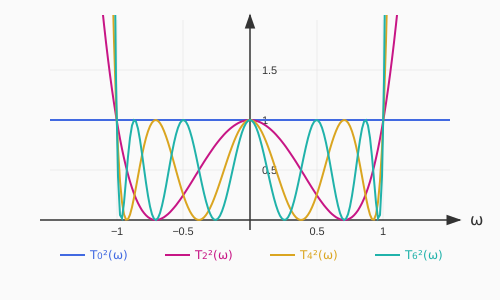
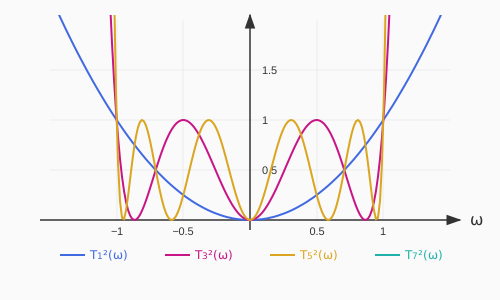
For $|\omega| \leq 1$, $T_n^2(\omega) \in [0, 1]$ oscillates, so $|H(\omega)|^2$ ripples within $[1/(1+\varepsilon^2),\; 1]$. For $|\omega| > 1$, $T_n^2(\omega)$ increases rapidly so $|H(\omega)|^2 \to 0$, and the transition becomes steeper as $n$ increases.
Designing the Ripple Parameter $\varepsilon$
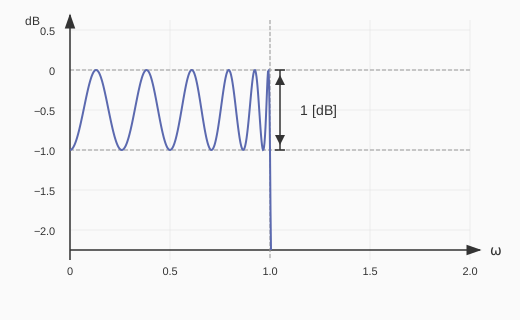
For the ripple to be $-r$ dB at the passband edge ($\omega = 1$), since $T_n(1) = 1$:
$$ |H(1)|^2 = \frac{1}{1 + \varepsilon^2} $$Setting this equal to $-r$ dB:
$$ 10 \log_{10} \frac{1}{1 + \varepsilon^2} = -r $$Solving for $\varepsilon$:
\begin{equation} \varepsilon = \sqrt{10^{r/10} - 1} \label{eq:epsilon} \end{equation}Representative ripple values and corresponding $\varepsilon$:
| Ripple $r$ [dB] | $\varepsilon$ | $|H(1)|^2$ |
|---|---|---|
| 0.1 | 0.1526 | 0.977 |
| 0.5 | 0.3493 | 0.891 |
| 1.0 | 0.5088 | 0.794 |
| 2.0 | 0.7648 | 0.631 |
| 3.0 | 0.9976 | 0.501 |
DC Gain
Difference between even and odd orders:
- Odd order: $T_n(0) = 0$, so $|H(0)|^2 = 1$ (DC gain = 0 dB)
- Even order: $T_n(0) = \pm 1$, so $|H(0)|^2 = \dfrac{1}{1+\varepsilon^2}$ (DC gain = $-r$ dB)
For even-order filters, DC lies at a ripple trough; for odd-order filters, DC is at the maximum gain.
Pole Locations
Eq.\eqref{eq:H2} gives the amplitude response on the imaginary axis ($s = j\omega$, $\omega$ real), but to find the filter poles we must extend this to the entire $s$-plane.
$$ |H(j\omega)|^2 = \frac{1}{1 + \varepsilon^2 T_n^2(\omega)} \tag{\ref{eq:H2} restated} $$Since the coefficients of the transfer function $H(s)$ are all real, the complex conjugate of $H(j\omega)$ equals $H(-j\omega)$:
$$ |H(j\omega)|^2 = H(j\omega)\,H(-j\omega) $$On the imaginary axis $s = j\omega$, so we can write $$\omega = s/j = -js$$ This substitution makes the right-hand side a rational function of $s$, defined over the entire $s$-plane:
$$ H(s)\,H(-s) = \frac{1}{1 + \varepsilon^2 T_n^2(-js)} $$Since $T_n(\omega)$ is a polynomial of degree $n$ in $\omega$, $T_n^2(-js)$ is a polynomial of degree $2n$ in $s$. Therefore the denominator $1 + \varepsilon^2 T_n^2(-js)$ is also a polynomial of degree $2n$ in $s$, and by the fundamental theorem of algebra, it has exactly $2n$ zeros (counting multiplicity), which are the poles of $H(s)\,H(-s)$. These poles are distributed symmetrically with respect to both the real and imaginary axes, and to obtain a stable filter $H(s)$, we must select only the $n$ poles in the left half-plane.
The pole positions are found by setting the denominator to zero:
$$ 1 + \varepsilon^2 T_n^2(-js) = 0 $$That is:
\begin{equation} T_n(-js) = \pm \frac{j}{\varepsilon} \label{eq:pole-condition} \end{equation}Derivation of Pole Positions
Identity \eqref{eq:Tn-cos} was derived solely from the addition formula for $\cos$ and the recurrence, so it holds for complex $\theta$ as well (defining $\cos\theta = (e^{j\theta} + e^{-j\theta})/2$, the addition formula follows from $e^{a+b} = e^a e^b$, which holds for complex numbers).
$$ T_n(\cos\theta) = \cos(n\theta) \tag{\ref{eq:Tn-cos} restated} $$We wish to apply this identity to $T_n(-js)$ in Eq.\eqref{eq:pole-condition}. Let $\theta = x + jy$ ($x, y$ real) be the complex number such that $\cos\theta = -js$:
$$ T_n(\underbrace{-js}_{\cos\theta}) = \cos(n\theta) = \pm \frac{j}{\varepsilon} $$That is:
$$ \cos(n(x + jy)) = \pm \frac{j}{\varepsilon} $$To expand the left-hand side, we first determine $\cos$ and $\sin$ for purely imaginary arguments. From Euler's formula definitions:
$$ \cos\theta = \frac{e^{j\theta} + e^{-j\theta}}{2}, \quad \sin\theta = \frac{e^{j\theta} - e^{-j\theta}}{2j} $$substituting $\theta = j\alpha$ ($\alpha$ real) gives:
\begin{align} \cos(j\alpha) &= \frac{e^{j \cdot j\alpha} + e^{-j \cdot j\alpha}}{2} = \frac{e^{-\alpha} + e^{\alpha}}{2} = \cosh\alpha \\[6pt] \sin(j\alpha) &= \frac{e^{j \cdot j\alpha} - e^{-j \cdot j\alpha}}{2j} = \frac{e^{-\alpha} - e^{\alpha}}{2j} = \frac{-(e^{\alpha} - e^{-\alpha})}{2j} = j \cdot \frac{e^{\alpha} - e^{-\alpha}}{2} = j\sinh\alpha \end{align}Using these results and the addition formula for $\cos$, we expand the left-hand side:
\begin{align} \cos(nx + j\,ny) &= \cos(nx)\cos(j\,ny) - \sin(nx)\sin(j\,ny) \\ &= \cos(nx)\cosh(ny) - j\sin(nx)\sinh(ny) \end{align}Therefore:
$$ \cos(nx)\cosh(ny) - j\sin(nx)\sinh(ny) = \pm \frac{j}{\varepsilon} $$Equating real and imaginary parts:
\begin{align} \cos(nx)\cosh(ny) &= 0 \\ \sin(nx)\sinh(ny) &= \mp \frac{1}{\varepsilon} \end{align}Since $\cosh(ny) > 0$, we need $\cos(nx) = 0$. Therefore:
$$ x = \frac{(2m+1)\pi}{2n}, \quad m = 0, 1, 2, \ldots $$In this case $\sin(nx) = \pm 1$, so:
$$ y = \pm \frac{1}{n} \sinh^{-1}\left(\frac{1}{\varepsilon}\right) $$Pole Coordinates
We now find the pole position $s$. Since we set $\cos\theta = -js$:
\begin{equation} s = \frac{\cos\theta}{-j} = j\cos\theta = j\cos(x + jy) \label{eq:s-from-theta} \end{equation}Expanding with the addition formula for $\cos$ as before:
\begin{align} \cos(x + jy) &= \cos(x)\cos(jy) - \sin(x)\sin(jy) \\ &= \cos(x)\cosh(y) - j\sin(x)\sinh(y) \end{align}Substituting into Eq.\eqref{eq:s-from-theta}:
\begin{align} s &= j\bigl[\cos(x)\cosh(y) - j\sin(x)\sinh(y)\bigr] \\ &= j\cos(x)\cosh(y) - j^2\sin(x)\sinh(y) \\ &= \sin(x)\sinh(y) + j\cos(x)\cosh(y) \end{align}Denoting the poles of $H(s)\,H(-s)$ by $p$:
\begin{equation} p = \sin(x)\sinh(y) + j\cos(x)\cosh(y) \label{eq:pole} \end{equation}The poles are distributed on an ellipse in the $s$-plane. The semi-axes (distances from center to edge) of the ellipse are:
- Real-axis direction (semi-minor axis): $a = \sinh(y)$
- Imaginary-axis direction (semi-major axis): $b = \cosh(y)$
where $y = \dfrac{1}{n}\sinh^{-1}\left(\dfrac{1}{\varepsilon}\right)$.
Selecting the Stable Poles
The denominator of $H(s)\,H(-s)$ is a polynomial of degree $2n$ in $s$, giving $2n$ poles. These are distributed symmetrically about both the real and imaginary axes of the $s$-plane.
To obtain a stable filter, we select only the left half-plane poles ($\text{Re}(p) < 0$). This reduces the filter order from $2n$ to $n$.
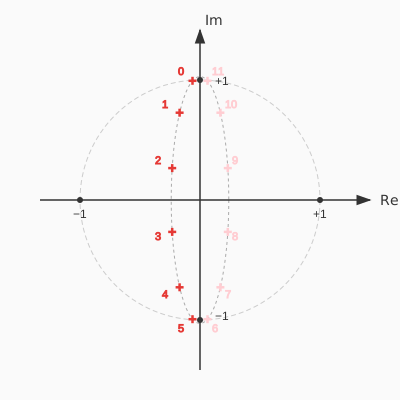
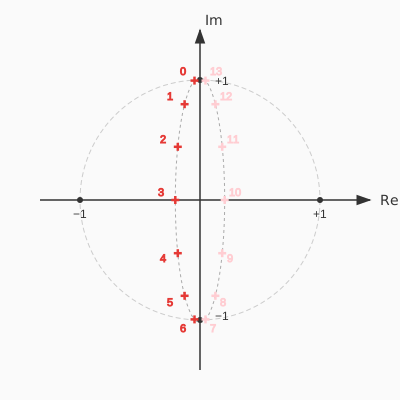
Dark-colored markers are the left half-plane poles used for the filter; light-colored markers are the unstable right half-plane poles that are discarded. The poles are equally spaced on the ellipse. For odd orders, one pole lies on the real axis.
Comparison with Butterworth
Butterworth filter poles are equally spaced on a circle of radius 1. In a Chebyshev filter, this circle deforms into an ellipse, and the poles move closer to the imaginary axis (yielding a steeper roll-off).
As the ripple $\varepsilon \to 0$, $y \to \infty$ and $\sinh(y) \approx \cosh(y)$, so the ellipse approaches a circle. This represents the asymptotic convergence to the Butterworth response.
Constructing the Transfer Function
From Poles to Transfer Function
Once the $n$ left half-plane poles $p_1, p_2, \ldots, p_n$ are found, the transfer function is:
\begin{equation} H(s) = \frac{K}{\prod_{k=1}^{n}(s - p_k)} \label{eq:transfer} \end{equation}The numerator constant $K$ is adjusted so that the DC gain or the gain at the passband edge is correct.
Decomposition into First- and Second-Order Sections
Real-axis pole (odd order)
For odd-order filters, when $m = (n-1)/2$, $x = \pi/2$ and $\cos(x) = 0$, so the pole lies on the real axis:
$$ p = -\sinh(y) \quad (\text{purely real}) $$The corresponding first-order section:
\begin{equation} H_1(s) = \frac{-p}{s - p} = \frac{\sinh(y)}{s + \sinh(y)} \label{eq:H1} \end{equation}Complex conjugate poles (second-order sections)
The remaining poles appear as complex conjugate pairs $p, p^*$:
$$ p, p^* = -\sin(x)\sinh(y) \pm j\cos(x)\cosh(y) $$Each pair is combined into a second-order section:
\begin{equation} H_2(s) = \frac{|p|^2}{(s-p)(s-p^*)} = \frac{|p|^2}{s^2 - 2\text{Re}(p) \cdot s + |p|^2} \label{eq:H2-section} \end{equation}where:
\begin{align} \text{Re}(p) &= -\sin(x)\sinh(y) \\ |p|^2 &= \sin^2(x)\sinh^2(y) + \cos^2(x)\cosh^2(y) = \frac{1}{2}(\cosh(2y) - \cos(2x)) \end{align}Correspondence with the Standard Form
The standard form of a second-order section is:
$$ H(s) = \frac{\omega_0^2}{s^2 + \frac{\omega_0}{Q}\,s + \omega_0^2} $$We compare coefficients with the denominator $s^2 - 2\text{Re}(p)\,s + |p|^2$ from Eq.\eqref{eq:H2-section}.
Comparing constant terms:
\begin{equation} \omega_0^2 = |p|^2 \quad \therefore\;\; \omega_0 = |p| \end{equation}Comparing coefficients of $s$:
$$ \frac{\omega_0}{Q} = -2\text{Re}(p) $$Solving for $Q$:
\begin{equation} Q = \frac{\omega_0}{-2\text{Re}(p)} = \frac{|p|}{-2\text{Re}(p)} \end{equation}Substituting $\text{Re}(p) = -\sin(x)\sinh(y)$:
\begin{equation} Q = \frac{\omega_0}{2\sin(x)\sinh(y)} \end{equation}