Filter Design
This page covers the design methods for digital and analog filters.
Digital Filters
Digital filters process discrete-time signals. FIR (finite impulse response) filters are always stable and can achieve linear-phase characteristics.
Classification of FIR Design Methods
| Method | Optimization Criterion | Characteristics |
|---|---|---|
| Parks-McClellan | $L^\infty$ (minimax) | Equiripple, worst-case guarantee |
| Least Squares | $L^2$ (minimum mean-square error) | Analytical, fast computation |
| Window Method | None (empirical) | Simple, intuitive |
| Frequency Sampling | None (interpolation) | FFT-based, fast |
| Chebyshev Interpolation | Interpolation at nodes | Theoretically grounded |
Minimax (Maximum Error Minimization)
Minimizes the worst-case error. Ideal when a guaranteed lower bound on stopband attenuation is required.
Parks-McClellan Method
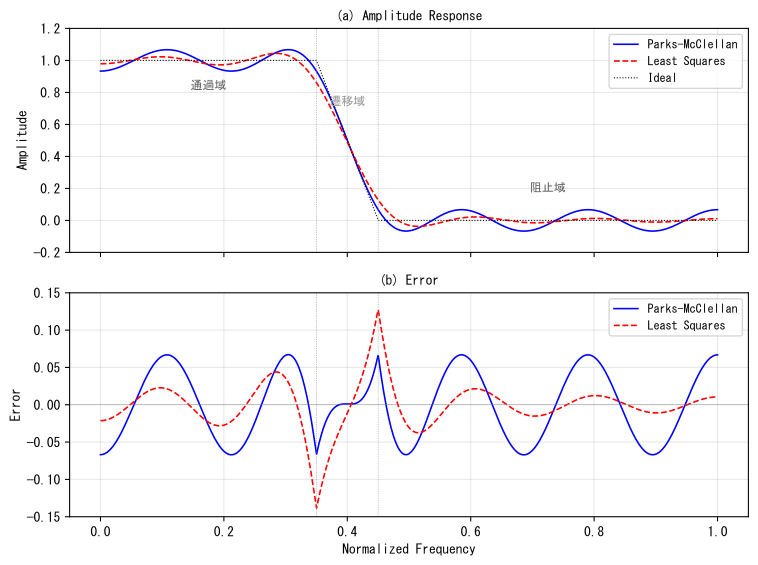
Optimal equiripple FIR filter design using the Remez exchange algorithm. Achieves the minimum maximum error for a given filter order.
Least Squares
Minimizes the average error. Can be solved analytically as a system of linear equations.
Least Squares Method
FIR filter design that minimizes the sum of squared errors. Extensions with weighting and constraints are also discussed.
Classical Methods
Computationally simple and easy to understand intuitively. Useful when requirements are relaxed or for educational purposes.
Window Method
Truncates the impulse response of an ideal filter with a window function. Simple and easy to implement.
Frequency Sampling Method
Specifies the desired frequency response at discrete points and obtains filter coefficients via the inverse DFT. Enables fast computation using the FFT.
Interpolation Methods
Designs that pass exactly through specified frequency points.
Chebyshev Interpolation
Filter design using interpolation at Chebyshev nodes. Avoids the Runge phenomenon and yields a stable approximation.
Comparison of Methods
Ripple Characteristics
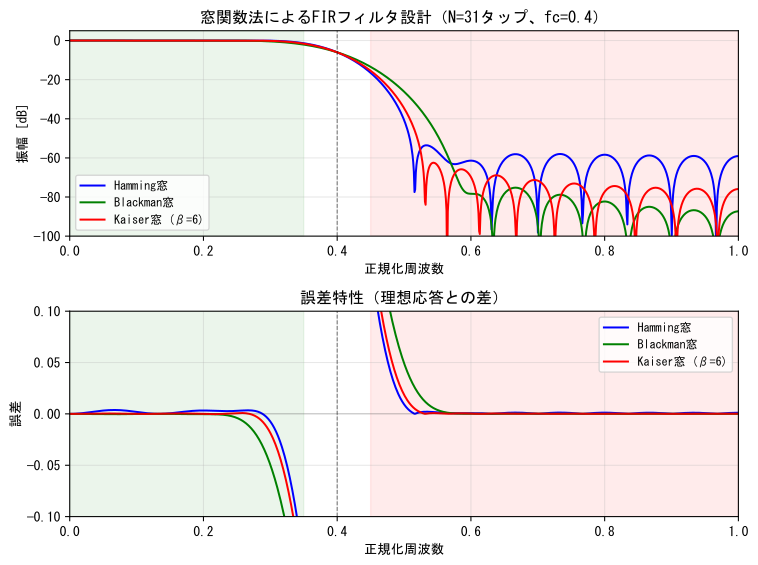
Window Method Comparison
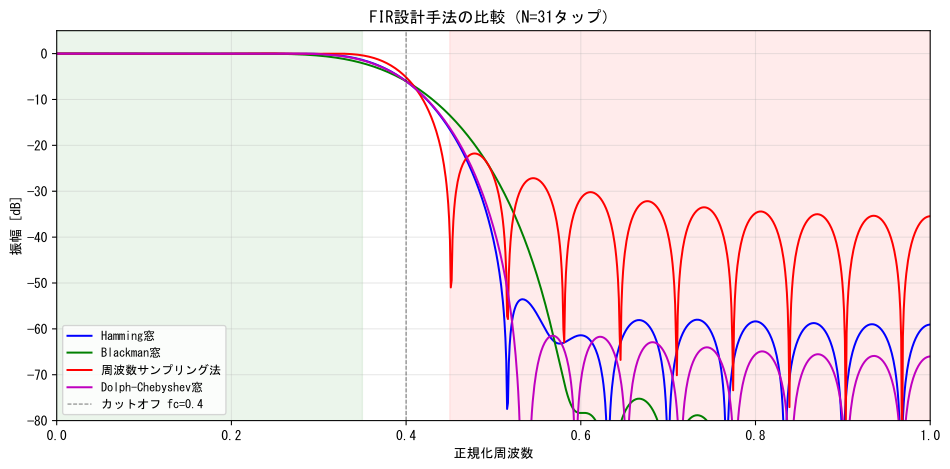
The window method applies a window function when truncating the impulse response of an ideal filter to finite length. The choice of window trades off passband ripple, stopband attenuation, and transition width.
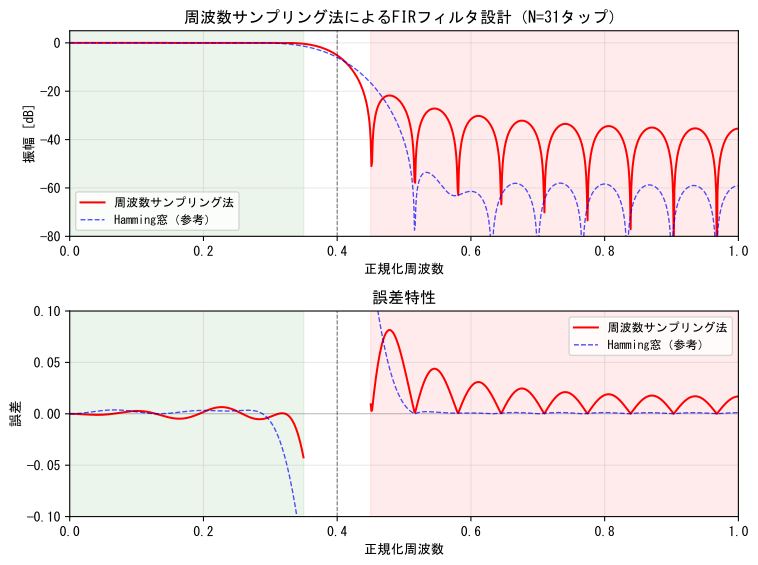
Frequency Sampling Method
The frequency sampling method samples the desired frequency response at discrete points and obtains the impulse response via the inverse DFT. Ripple can be reduced by introducing interpolation samples in the transition band. Fast computation via the FFT is possible.
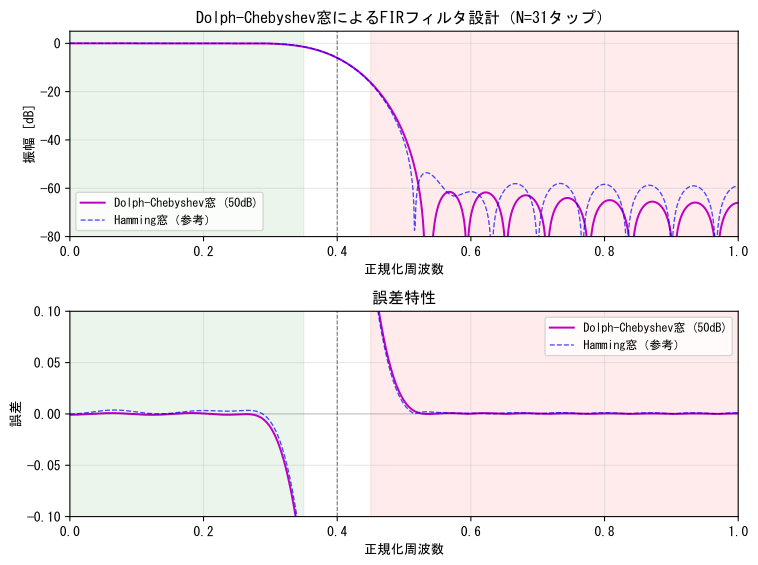
Dolph-Chebyshev Window
The Dolph-Chebyshev window is the optimal window that produces equal-level sidelobes for a given main-lobe width. It yields equiripple sidelobe characteristics at a specified attenuation level.
Comparison of All Methods
Selection Guidelines
- Guaranteed stopband attenuation required → Parks-McClellan method
- Computational speed is critical → Window method or frequency sampling method
- Average performance matters most → Least squares method
- Precise control at specific frequencies → Frequency sampling or Chebyshev interpolation
- Real-time updates (adaptive filtering) → Least squares (LMS, etc.)
Analog Filters
Analog filters process continuous-time signals. IIR (infinite impulse response) digital filters are often obtained by digitizing an analog filter design via the bilinear transform or similar techniques.
Classical Analog Filters
| Filter | Passband | Stopband | Characteristics |
|---|---|---|---|
| Butterworth | Monotonic | Monotonic | Maximally flat response |
| Chebyshev Type I | Equiripple | Monotonic | Sharp cutoff |
| Chebyshev Type II | Monotonic | Equiripple | No passband ripple |
| Elliptic (Cauer) | Equiripple | Equiripple | Sharpest cutoff |
Selection Guidelines
- Passband flatness is critical → Butterworth
- Narrow transition band required → Chebyshev Type I or elliptic
- Flat passband with tolerable stopband ripple → Chebyshev Type II
- Meet the specification with minimum order → Elliptic filter
- Group delay characteristics matter → Bessel