Chebyshev Filter
Summary
- The Chebyshev filter is an analog filter with equiripple characteristics in either the passband or the stopband
- Type I: equiripple in the passband, monotonically decreasing in the stopband, all-pole topology for simpler circuits
- Type II: ripple-free, monotonically decreasing passband, equiripple in the stopband, finite transmission zeros require more components
- For the same amplitude specification, it can usually be realized with a lower order than Butterworth (the narrower the transition band, the larger the reduction)
- Main applications: communication systems, RF circuits, and measurement instrument filters
The Chebyshev filter is an analog filter with equiripple characteristics in either the passband or the stopband. It is designed based on Chebyshev polynomials, studied by the Russian mathematician Pafnuty Chebyshev (1821--1894). It can achieve a steeper cutoff than the Butterworth filter, but introduces ripple in either the passband or the stopband.
Differences Between Type I and Type II
There are two types of Chebyshev filters.
Type I
Equiripple in the passband, monotonically decreasing in the stopband.
Squared magnitude response (lowpass prototype):
$$|H(\omega)|^2 = \frac{1}{1 + \varepsilon^2 T_n^2(\omega/\omega_c)}$$Design parameter: passband ripple $R_p$ [dB] (written $r$ on the Type I theory page)
$\varepsilon = \sqrt{10^{R_p/10} - 1}$, and $\omega_c$ is the passband edge: the attenuation at $\omega = \omega_c$ is exactly $R_p$ dB, unlike the $-3$ dB point of a Butterworth filter. For even orders the gain at $\omega = 0$ is also $-R_p$ dB.
Poles: located on an ellipse
Zeros: none (all-pole type)
Type II (Inverse Chebyshev)
Monotonically decreasing in the passband, equiripple in the stopband.
Squared magnitude response (lowpass prototype):
$$|H(\omega)|^2 = \frac{1}{1 + \dfrac{1}{\varepsilon^2 T_n^2(\omega_s/\omega)}}$$Design parameter: stopband attenuation $A_s$ [dB]
$\varepsilon = 1/\sqrt{10^{A_s/10} - 1}$, and $\omega_s$ is the stopband edge (the attenuation at $\omega = \omega_s$ is exactly $A_s$ dB). The symbols are the same as for Type I, but they denote different quantities.
Poles: reciprocals $1/p_k$ of the Type I poles $p_k$ determined from $A_s$ (normalized to $\omega_s = 1$); not on an ellipse
Zeros: located on the imaginary axis
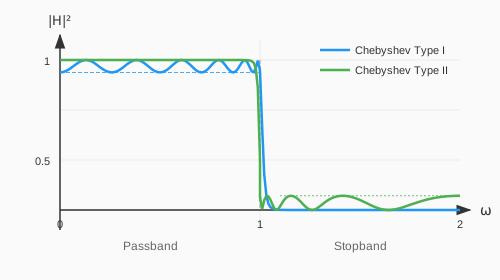
Which One to Choose
| Condition | Recommendation |
|---|---|
| Passband flatness is important | Type II or Butterworth |
| Monotonically decreasing stopband is desired | Type I |
| Simple circuit required (no zeros) | Type I |
| Equiripple reflection (Chebyshev-type matching) wanted for RF applications | Type I |
Why Type II is less common: Type II must realize finite-frequency transmission zeros, so even though its required order is about the same as Type I, the circuit can be more complex depending on the implementation. Furthermore, passive LC ladder synthesis is more naturally suited to Type I, and when passband ripple is also acceptable, the steeper and lower-order elliptic filter is often used instead. For these reasons, Type I is overwhelmingly more common in practice, and "Chebyshev filter" typically refers to Type I.
Comparison with Other Filters
| Filter | Passband | Stopband | Transition Band | Phase Response (rough guide to group-delay flatness) |
|---|---|---|---|---|
| Butterworth | Monotonically decreasing (maximally flat) | Monotonically decreasing | Gradual | Better than Chebyshev |
| Chebyshev Type I | Equiripple | Monotonically decreasing | Steep | Somewhat inferior |
| Chebyshev Type II | Monotonically decreasing (maximally flat) | Equiripple | Steep | Somewhat inferior |
| Elliptic | Equiripple | Equiripple | Steepest | Inferior |
| Bessel | Monotonically decreasing | Monotonically decreasing | Most gradual | Best (near-linear phase) |
The phase-response column is a rough comparison of group-delay flatness for lowpass prototypes of similar order; the ranking can change with the criterion (group-delay flatness or phase linearity, and the frequency range compared).
Order Comparison Example for a Fixed Amplitude Specification
Required filter order to meet the following amplitude specification: passband ripple $R_p = 1$ dB, stopband attenuation $A_s = 40$ dB, transition band ratio $\omega_s/\omega_p = 1.5$:
| Filter | Required Order |
|---|---|
| Bessel | — (see note) |
| Butterworth | 14 |
| Chebyshev Type I | 7 |
| Chebyshev Type II | 7 |
| Elliptic | 5 |
Note: a Bessel filter is normalized by its group delay, so its order cannot be determined from this amplitude specification (1 dB / 40 dB / $\omega_s/\omega_p = 1.5$).
In this example, Chebyshev Type I achieves equivalent transition characteristics with half the order of a Butterworth filter. The degree of order reduction depends strongly on the specification: the narrower the transition band (the closer $\omega_s/\omega_p$ is to 1), the larger the reduction, whereas for loose specifications with $\omega_s/\omega_p$ above about 3 the order can be the same as Butterworth. Whatever reduction is obtained translates to fewer components and reduced computational cost in digital implementations.
For a lowpass prototype ($\omega_s > \omega_p$) with an amplitude specification, the required order of Chebyshev Type I is $$n \geq \frac{\cosh^{-1}\left(\sqrt{\dfrac{10^{A_s/10} - 1}{10^{R_p/10} - 1}}\right)}{\cosh^{-1}(\omega_s/\omega_p)}$$ rounded up to the next integer (in the example above the right-hand side is 6.21, hence order 7). For highpass and bandpass filters, first convert to the equivalent lowpass specification by frequency transformation. See the Design page for the derivation and worked examples.
Applications
- Communication systems: channel filters, IF filters
- RF/microwave: impedance matching circuits (equiripple reflection characteristics)
- Measurement instruments: anti-aliasing filters
Detailed Topics
Theory (Type I)
Properties of Chebyshev polynomials, squared magnitude response, and mathematical derivation of elliptical pole placement.
Theory (Type II)
Magnitude response of the inverse Chebyshev filter, zero locations, pole placement, and transfer function construction.
Frequency Response
Detailed magnitude, phase, and group delay characteristics. Comparison graphs with Butterworth.
Design
Order determination from specifications, design procedure, and Python implementation examples.
Circuits
Implementation using Sallen-Key, MFB, state-variable filters, and LC ladders, with component selection guidelines.
Component Value Tables
Normalized LC ladder filter element value tables (orders 1--10, various ripple levels).
Online Design Tool
Design in your browser. Enter parameters to automatically generate coefficients and frequency response plots.
Summary
The Chebyshev filter is an analog filter that, by allowing ripple in either the passband or the stopband, achieves a steeper transition than a Butterworth filter of the same amplitude specification, usually at a lower order.
- Choose Type I when: passband ripple is acceptable and a steep cutoff with a simple circuit (all-pole type) is needed
- Choose Type II when: passband ripple must be avoided and stopband ripple is acceptable
- Consider other filters when: phase response is critical (Bessel), or minimum order for an amplitude-only specification is needed (elliptic)
In practice, Type I is overwhelmingly more common, and "Chebyshev filter" typically refers to Type I. During design, compute the required order from the passband ripple, stopband attenuation, and transition band ratio, then obtain the coefficients from element value tables or a design tool.
References
- A. B. Williams and F. J. Taylor, Electronic Filter Design Handbook, 4th ed., McGraw-Hill, 2006.
- A. I. Zverev, Handbook of Filter Synthesis, Wiley, 1967.
- R. Schaumann, M. S. Ghausi, and K. R. Laker, Design of Analog Filters, Prentice Hall, 1990.