Chebyshev Type II Filter Theory
Amplitude Response, Zeros, and Pole Locations of the Inverse Chebyshev Filter
This article explains the theory of Chebyshev Type II (inverse Chebyshev) filters. The key difference from Type I is that the passband is monotonically decreasing while the stopband exhibits equiripple behavior. For the fundamentals of Type I, see Type I Theory.
Amplitude-Squared Response
The amplitude-squared response of Type II is defined as follows:
\begin{equation} |H(\omega)|^2 = \frac{1}{1 + \dfrac{1}{\varepsilon^2 T_n^2(1/\omega)}} \label{eq:H2-type2} \end{equation}Compared with the Type I expression $|H(\omega)|^2 = \dfrac{1}{1 + \varepsilon^2 T_n^2(\omega)}$, $\omega$ is replaced by $1/\omega$ and $\varepsilon^2$ is replaced by $1/\varepsilon^2$.
Differences in Amplitude Response from Type I
| Characteristic | Type I | Type II |
|---|---|---|
| Passband ($\omega < 1$) | Equiripple | Monotonically decreasing (nearly maximally flat) |
| Stopband ($\omega > \omega_s$) | Monotonically decreasing | Equiripple |
| DC gain | Odd order: 0 dB, Even order: $-r$ dB | Always 0 dB |
| Transition band steepness | Steeper | Slightly more gradual |
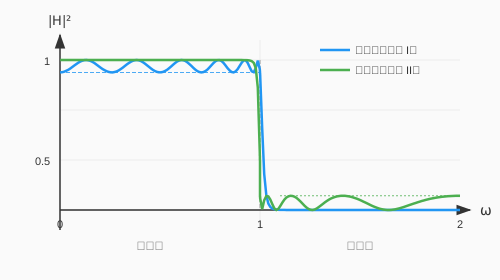
Stopband Attenuation Parameter
For Type II, instead of passband ripple, the minimum stopband attenuation $A_s$ [dB] is specified. The ripple parameter $\varepsilon$ is determined by the following relation:
\begin{equation} \varepsilon = \frac{1}{\sqrt{10^{A_s/10} - 1}} \label{eq:epsilon-type2} \end{equation}| Stopband attenuation $A_s$ [dB] | $\varepsilon$ |
|---|---|
| 20 | 0.1005 |
| 30 | 0.0317 |
| 40 | 0.0100 |
| 50 | 0.00316 |
| 60 | 0.00100 |
Existence of Zeros
The most distinctive feature of Type II is that it possesses zeros (transmission zeros) on the imaginary axis. Type I is an all-pole design (no zeros), whereas Type II has both poles and zeros.
The zeros drive the amplitude response to exactly zero at specific frequencies within the stopband. This is what produces the equiripple characteristic in the stopband.
Zero Locations
An $n$th-order Type II filter has $\lfloor n/2 \rfloor$ complex-conjugate zero pairs. The zeros lie on the imaginary axis ($s = \pm j\omega_z$):
\begin{equation} z_k = \pm j\omega_s \sec\left(\frac{(2k-1)\pi}{2n}\right), \quad k = 1, 2, \ldots, \lfloor n/2 \rfloor \label{eq:zeros} \end{equation}Here $\omega_s$ is the stopband edge frequency and $\sec(\theta) = 1/\cos(\theta)$.
Numerical Example of Zeros ($n = 5$, $\omega_s = 1$)
| $k$ | Angle $(2k-1)\pi/(2n)$ | $\sec(\cdot)$ | Zero $z_k$ |
|---|---|---|---|
| 1 | $\pi/10 = 18°$ | 1.0515 | $\pm j1.0515$ |
| 2 | $3\pi/10 = 54°$ | 1.7013 | $\pm j1.7013$ |
A 5th-order filter has 2 pairs (4 individual) zeros. For $k = 3$, the angle is $\pi/2 = 90°$ and $\sec(90°) = \infty$, so for odd orders one zero is interpreted as being at infinity (effectively no zero).
Pole Locations
The Type II poles $q_k$ can be derived from the Type I poles $p_k$:
\begin{equation} q_k = \frac{\omega_s^2}{p_k^*} \label{eq:poles-type2} \end{equation}Here $p_k^*$ denotes the complex conjugate of the Type I pole. This transformation places the Type II poles $q_k$ farther from the imaginary axis (greater damping) than the Type I poles $p_k$.
Difference in pole placement: The Type I poles $p_k$ are located closer to the inner side of the ellipse, while the Type II poles $q_k$ are placed closer to the outer side. As a result, Type II exhibits better group delay characteristics than Type I (though with a more gradual roll-off).
Transfer Function Construction
The Type II transfer function includes both poles and zeros:
\begin{equation} H(s) = K \cdot \frac{\prod_{k}(s^2 + \omega_{z,k}^2)}{\prod_{k}(s - q_k)(s - q_k^*)} \label{eq:transfer-type2} \end{equation}The numerator factors $(s^2 + \omega_{z,k}^2)$ represent the zeros; the numerator vanishes at $s = \pm j\omega_{z,k}$.
Decomposition into Second-Order Sections
Each second-order section of a Type II filter takes the biquad form with zeros:
\begin{equation} H_k(s) = K_k \cdot \frac{s^2 + \omega_{z,k}^2}{s^2 + \frac{\omega_{0,k}}{Q_k}s + \omega_{0,k}^2} \label{eq:biquad-type2} \end{equation}This has the characteristic of a notch-plus-lowpass filter. It provides complete attenuation at the zero frequency $\omega_{z,k}$ and a peak near the pole frequency $\omega_{0,k}$.
Choosing Between Type I and Type II
| Requirement | Recommendation |
|---|---|
| Passband flatness is important | Type II (no passband ripple) |
| Transition band steepness is the top priority | Type I (steeper for the same order) |
| Complete rejection at specific stopband frequencies | Type II (complete attenuation via zeros) |
| Simpler circuit implementation | Type I (all-pole; no zero-producing circuitry needed) |
| Improved group delay characteristics | Type II (poles are farther from the imaginary axis) |
Practical note: Because Type II has zeros, its analog circuit implementation is more complex than Type I. Sallen-Key and MFB topologies cannot directly realize zeros, so state-variable or biquad circuits are required. See the circuit design section for details.