Chapter 4: Definition of the Derivative
The Derivative at a Point and the Derivative Function
4.1 The Derivative at a Point
Building on the groundwork laid so far, we now give the formal definition of the derivative.
The derivative of a function $f(x)$ at $x = a$ is defined by the following limit:
$$f'(a) = \lim_{h \to 0} \dfrac{f(a+h) - f(a)}{h}$$When this limit exists, we say that $f(x)$ is differentiable at $x = a$.
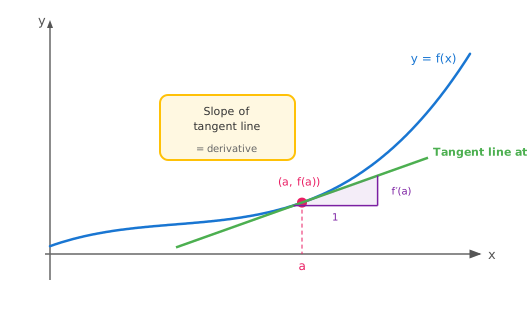
As shown in Figure 1, the derivative $f'(a)$ represents the slope of the tangent line to the curve $y = f(x)$ at the point $(a, f(a))$.
Alternative Form
By substituting $x = a + h$ (so that $x \to a$ as $h \to 0$), the derivative can also be written as
$$f'(a) = \lim_{x \to a} \dfrac{f(x) - f(a)}{x - a}$$4.2 The Derivative Function
Instead of computing the derivative at a single fixed point $a$, we can regard it as a function of the variable $x$, giving us the derivative function.
The derivative function of $f(x)$ is:
$$f'(x) = \lim_{h \to 0} \dfrac{f(x+h) - f(x)}{h}$$The derivative function $f'(x)$ is a new function that gives the "slope of the tangent = rate of change" at each point $x$ of the original function $f(x)$. The steeper the slope, the greater the change when $x$ is varied.
- If $f(x)$ is "position," then $f'(x)$ is "velocity"
- If $f(x)$ is "quantity," then $f'(x)$ is "rate of increase"
- If $f(x)$ is a graph, then $f'(x)$ is "the slope at each point"
4.3 Notation for Derivatives
Several different notations are used for derivatives. They all mean the same thing.
| Notation | Read as | Notes |
|---|---|---|
| $f'(x)$ | "f prime of x" | Lagrange's notation. The most common. |
| $\dfrac{df}{dx}$ | "dee f dee x" | Leibniz's notation. Can be manipulated like a fraction. |
| $\dfrac{dy}{dx}$ | "dee y dee x" | Used when $y = f(x)$. Makes the rate-of-change meaning explicit. |
| $\dfrac{d}{dx}f(x)$ | "dee dee x of f of x" | Treats $\dfrac{d}{dx}$ as a "differentiation operator." |
| $\dot{y}$ | "y dot" | Newton's notation. Used for time derivatives. |
Although $\dfrac{dy}{dx}$ looks like a fraction, it does not mean that $dy$ and $dx$ are taken separately and divided. It stands for
$$\dfrac{dy}{dx} = \lim_{\Delta x \to 0} \dfrac{\Delta y}{\Delta x}$$a single symbol representing the entire limit operation. While $\dfrac{\Delta y}{\Delta x}$ is indeed a fraction (a ratio of finite changes), after taking the limit $\Delta x \to 0$ the expression $\dfrac{dy}{dx}$ is no longer "something divided by something" — it is the limit value itself.
However, in the chain rule for composite functions,
$$\dfrac{dy}{dx} = \dfrac{dy}{du} \cdot \dfrac{du}{dx}$$it looks as if $du$ cancels out. In integration by substitution, too, one can write $dx = \dfrac{dx}{du}\,du$ as if $dx$ were a fraction. The fact that the rules of fractions often carry over to computations with $dy/dx$ is a major advantage of Leibniz notation.
4.4 Differentiability
Not every function is differentiable.
A function $f(x)$ is said to be differentiable at $x = a$ if
$$\lim_{h \to 0} \dfrac{f(a+h) - f(a)}{h}$$exists (i.e., is a finite number).
A Non-Differentiable Example: A Corner
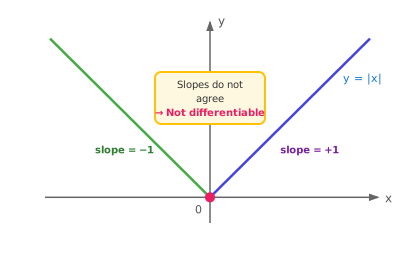
Consider $f(x) = |x|$. Let us examine the derivative at $x = 0$.
Left-hand limit (when $h < 0$):
$$\lim_{h \to 0^-} \dfrac{|0+h| - |0|}{h} = \lim_{h \to 0^-} \dfrac{|h|}{h} = \lim_{h \to 0^-} \dfrac{-h}{h} = -1$$Right-hand limit (when $h > 0$):
$$\lim_{h \to 0^+} \dfrac{|0+h| - |0|}{h} = \lim_{h \to 0^+} \dfrac{|h|}{h} = \lim_{h \to 0^+} \dfrac{h}{h} = +1$$Since the left-hand limit $(-1)$ and the right-hand limit $(+1)$ disagree, the limit does not exist.
Therefore, $f(x) = |x|$ is not differentiable at $x = 0$.
If $f(x)$ is differentiable at $x = a$, then $f(x)$ is continuous at $x = a$.
(The converse is false: a function can be continuous without being differentiable.)
4.5 Worked Examples
Example 1: Constant Function $f(x) = c$
Step 1: Set up the definition
$$f'(x) = \lim_{h \to 0} \dfrac{f(x+h) - f(x)}{h}$$Step 2: Substitute $f(x+h)$ and $f(x)$
Since $f(x)$ is constant, $f(x) = f(x+h) = c$. Therefore:
$$f'(x) = \lim_{h \to 0} \dfrac{c - c}{h} = \lim_{h \to 0} \dfrac{0}{h} = \lim_{h \to 0} 0 = 0$$Result: $f'(x) = 0$
Example 2: Linear Function $f(x) = mx + n$
Step 1: Compute $f(x+h)$
$$f(x+h) = m(x+h) + n = mx + mh + n$$Step 2: Compute $f(x+h) - f(x)$
$$f(x+h) - f(x) = (mx + mh + n) - (mx + n) = mh$$Step 3: Divide by $h$
$$\dfrac{f(x+h) - f(x)}{h} = \dfrac{mh}{h} = m \quad (h \neq 0)$$Step 4: Take the limit
$$f'(x) = \lim_{h \to 0} m = m$$Result: $f'(x) = m$
The derivative of a linear function equals its slope $m$, which matches our intuition.
Example 3: Quadratic Function $f(x) = x^2$
Step 1: Expand $f(x+h)$
$$f(x+h) = (x+h)^2 = x^2 + 2xh + h^2$$Step 2: Compute $f(x+h) - f(x)$
$$f(x+h) - f(x) = (x^2 + 2xh + h^2) - x^2 = 2xh + h^2$$Step 3: Divide by $h$
$$\dfrac{f(x+h) - f(x)}{h} = \dfrac{2xh + h^2}{h} = \dfrac{h(2x + h)}{h} = 2x + h \quad (h \neq 0)$$Step 4: Take the limit
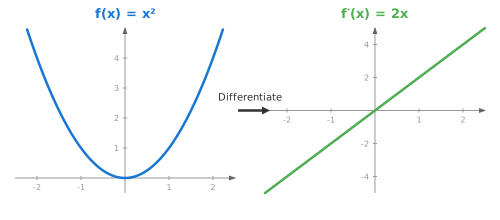
$$f'(x) = \lim_{h \to 0} (2x + h) = 2x$$Result: $(x^2)' = 2x$
Chapter Summary
- Derivative at a point: $f'(a) = \displaystyle\lim_{h \to 0} \frac{f(a+h) - f(a)}{h}$ (a constant representing the slope of the tangent at $a$)
- Derivative function: $f'(x) = \displaystyle\lim_{h \to 0} \frac{f(x+h) - f(x)}{h}$ (a function giving the slope at each point $x$)
- Notation: $f'(x)$, $\dfrac{df}{dx}$, $\dfrac{dy}{dx}$, etc.
- Differentiable: the limit exists
- Basic formulas: $(c)' = 0$, $(mx + n)' = m$, $(x^2)' = 2x$