Why You Cannot Flatten an Orange Peel — Curvature Seen from the Inside
Gauss's Theorema Egregium, in plain words
Reading
Peel an orange and try to lay a single piece of its skin flat on a table. However carefully you do it, somewhere it always tears, wrinkles, or curls up at the edge. No matter how gently you work, the peel never becomes one flat sheet. It looks obvious, yet this is in fact a rather deep truth.
The same thing happens on a far larger scale. Transfer the surface of a globe onto a flat world map, and Greenland swells to the size of South America, or shapes get twisted out of true. A perfect world map is impossible in principle. What links the orange peel and the world map is a remarkable theorem found by Gauss in the nineteenth century: curvature is determined by the inside of a surface alone. Today let us follow that story in a relaxed way.
Paper Bends, but Does Not Stretch
First, picture a sheet of paper. Roll the flat sheet on your desk into a tube, or let it ripple. The paper is certainly “bent” now. Yet, curiously, the lengths, angles, and areas of any figure drawn on it do not change at all. Before and after bending, the geometry on the paper is exactly the same.
So bending comes in two kinds. One is how the surface curves as seen from the surrounding space — the apparent bending. The other is a curvature intrinsic to the surface itself, one that actually affects the lengths and angles on it; below we call it, familiarly, the true bending. Paper rolled into a tube is bent in the first sense but not at all in the second. Carrying over to surfaces the very idea by which curve theory assigns a curvature to a single curve makes this distinction stand out sharply.
Here let us fix one rule to keep throughout. A surface may be bent, but never stretched or compressed — like paper or an orange peel, it can be rolled, but the material itself does not stretch or shrink. This “no stretching” is the foundation that supports the whole story. If stretching were allowed, even a curved surface could be forced flat — but then the lengths and areas on it would be distorted without mercy, and that is the world-map story that comes later. Only under the promise of no stretching, no shrinking does “curvature” become an immovable, genuine property.
And an orange peel or a sphere, unlike paper, possesses the true bending just described. That is exactly why, unless you allow yourself to stretch it, it cannot be spread flat the way paper can.
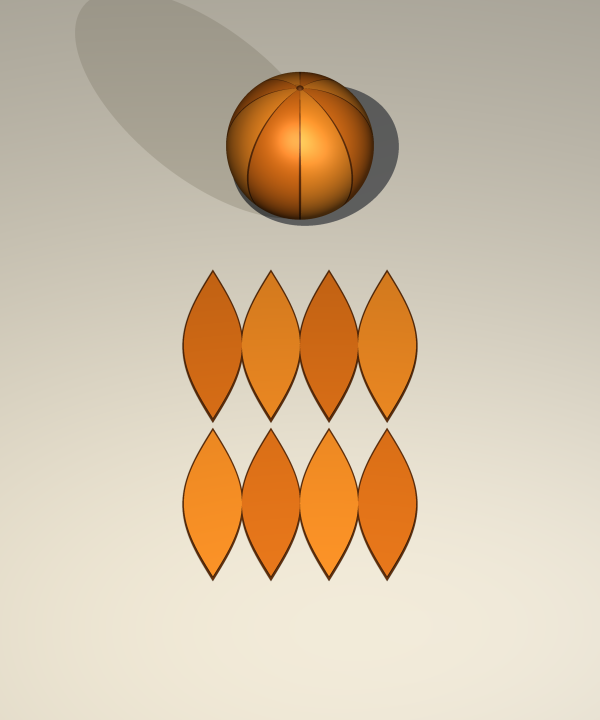
Cut it, bend it — some curvature stubbornly remains. Then how should we measure, as a number, the strength of this “curvature that will not go away”?
Gaussian Curvature: A Single Number
The true bending at a point of a surface (a property of the surface itself, so it is also called the intrinsic curvature), gathered into a single number, is the Gaussian curvature $K$. The idea is this. Cut the surface at that point in various directions, and the sharpness of the cross-section's bend changes with the direction. Among them, the direction that bends the most and the direction that bends the least (these two are always perpendicular) give bending values called the principal curvatures $\kappa_1,\kappa_2$, and multiplying them gives the Gaussian curvature $K=\kappa_1\kappa_2$. Picking two arbitrary directions and multiplying does not give $K$ — only when you choose these two, the maximum and the minimum, does the product come out to exactly $K$.
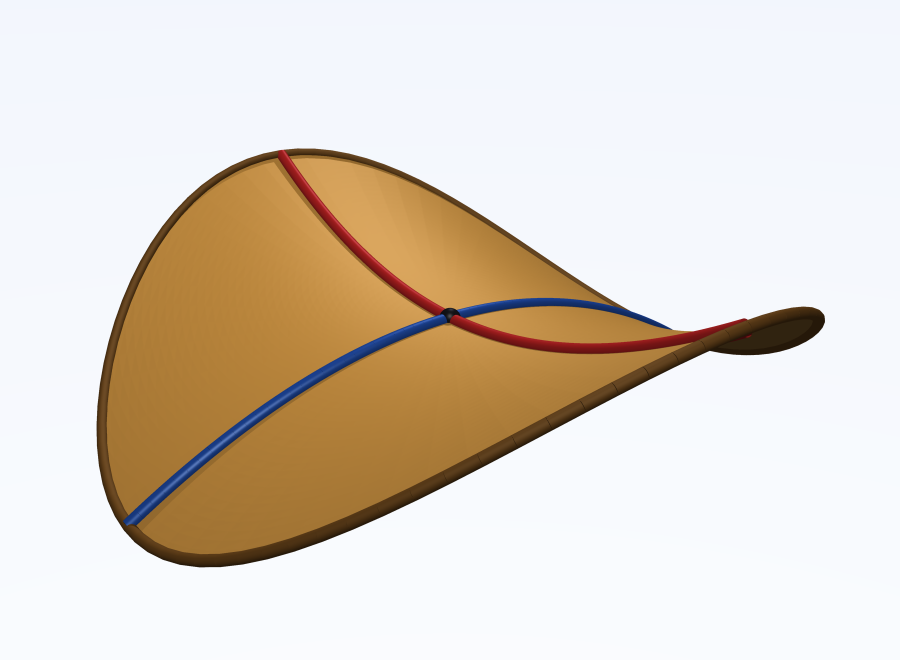
The fact that it is a product is what matters. On a surface like a sphere, curving to the same side in every direction, the two curvatures share a sign, so $K>0$. On a horse's saddle or a potato chip, arching one way and the opposite way the other, the signs differ, so $K<0$. And on flat paper or the side of a cylinder, at least one curvature is zero, so the product is $K=0$ as well. A cylinder is bent in appearance, yet its Gaussian curvature is zero — this is the real identity of the earlier feeling that “paper can be bent but not stretched.” The detailed computational framework is provided by surface theory.
Quick note: there is a reason for a potato chip's shape
A potato chip is arched into that saddle shape for a reason, not by accident. A saddle with $K<0$ is a flat disk made to ripple with excess along its rim, and it stiffens the chip and makes it harder to break (breakability also depends on thickness and moisture, of course, but the shape genuinely matters). To break a chip you must bend it, but to bend a surface already arched in two directions any further, you have no choice but to stretch or compress the material (a surface's curvature cannot be changed without stretching — the Theorema Egregium of the next section). A hard, unstretchable chip refuses this, so it is hard to bend and hard to break. A flat chip, needing no stretching, simply snaps.
 arches up
arches down
arches up
arches down
The Theorem That Astonished Gauss
Up to here, the definition of Gaussian curvature was a matter of placing the surface in the surrounding space and measuring the bending of cross-sections from outside. But in 1827 Gauss proved an incredible fact: Gaussian curvature is determined, without looking at the surrounding space at all, from the lengths and angles measurable inside the surface alone.
It was so unexpected that Gauss himself named it, in Latin, Theorema Egregium — the “remarkable theorem.” Why remarkable? The definition $K=\kappa_1\kappa_2$ contains information that looks thoroughly external — which way, and by how much, the surface arches in the outer space. Yet that product alone can be recovered by internal surveying, without looking outside. The two principal curvatures depend on outside information, but their product is closed within the inside.
What this means is that a two-dimensional inhabitant living on the surface, unable to step outside, can know “whether the surface I live on is curved” merely by measuring the geometry underfoot. Curvature belonged not to the tourist gazing from outside, but also to the one dwelling inside. This idea of telling a world's curvature from the inside runs straight on later to Riemannian geometry, and further to general relativity, which treats curved spacetime.
Measuring Curvature by a Triangle's Angle Sum
So how, concretely, does the inside inhabitant measure curvature? The most famous way is the angle sum of a triangle. On a flat surface, the interior angles of a triangle sum to exactly $180^\circ$; this has been common sense since Euclid. But on a curved surface, that is not so.
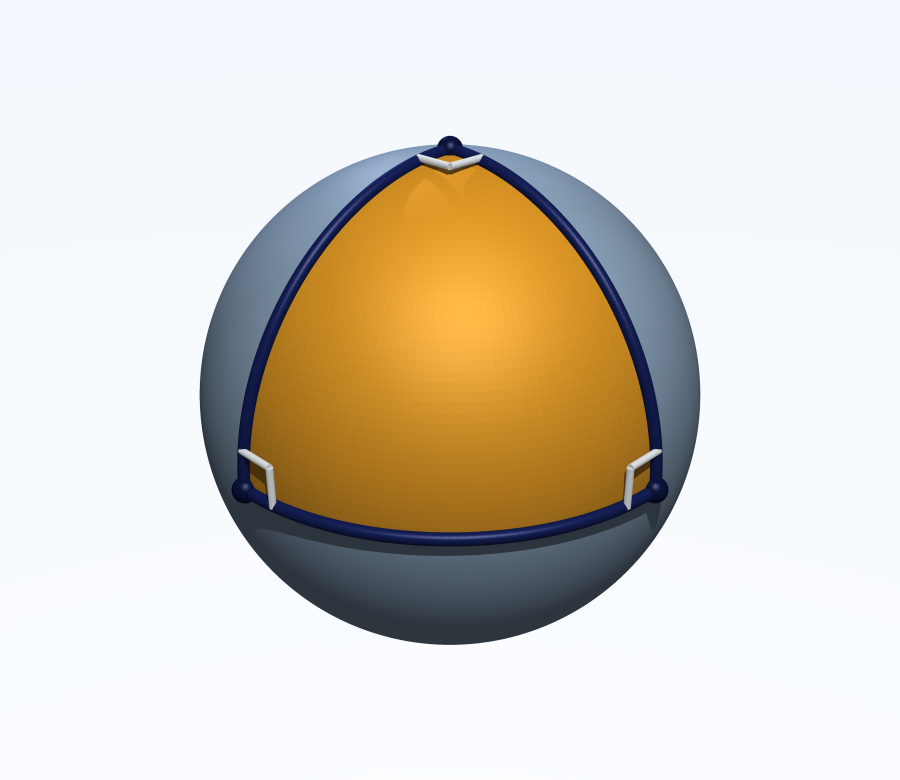
On a globe, consider a path that goes straight down from the North Pole to the equator, moves $90^\circ$ along the equator, and then goes straight back up to the North Pole. All three angles are right angles, so the angle sum is $270^\circ$ — well beyond $180^\circ$. This is because the sphere has $K>0$. Conversely, on a saddle-shaped surface ($K<0$), the angle sum is less than $180^\circ$. The deviation from $180^\circ$ equals exactly the total amount of curvature the triangle encloses (more precisely, it equals the integral of the Gaussian curvature over the enclosed region, $\iint_{\triangle} K\,dS$). This is the Gauss–Bonnet theorem, a jewel of intrinsic geometry.
 North Pole
90°
90°
Equator
North Pole
90°
90°
Equator
The same happens with circles. In the plane, a circle of radius $r$ has circumference $2\pi r$, but a circle drawn on a sphere has a circumference shorter than $2\pi r$, and on a saddle longer. How far the circumference deviates from what is expected, given the radius measured from the center — that ratio of deviation again reveals the curvature. With only a tape measure and a protractor, the inhabitant can survey the shape of the world without looking up at the sky. Drawing triangles along the “straight lines” of a curved surface — the geodesics, such as a great circle — is the basis of that survey.
Why a Perfect World Map Cannot Exist
The Theorema Egregium unexpectedly turns its blade on a practical problem too: the fate that an accurate world map cannot exist in principle.
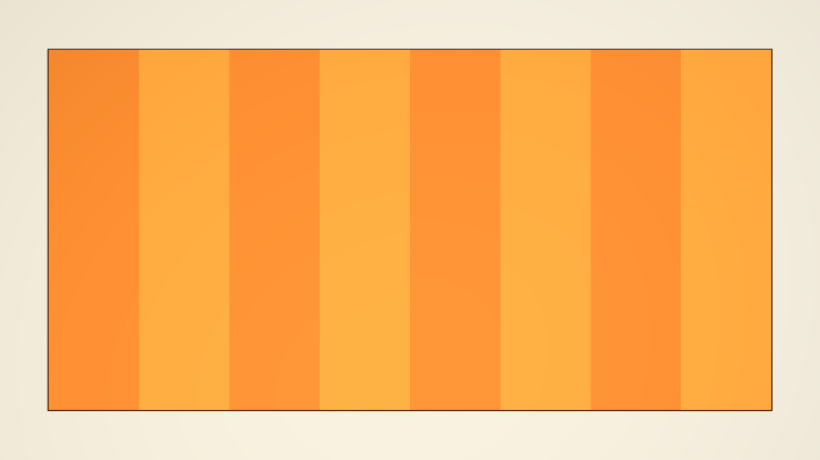
The surface of the Earth is a sphere with $K>0$; a paper map is a plane with $K=0$. Since Gaussian curvature is an invariant fixed by internal surveying, unless stretching is allowed, mapping the sphere onto the plane is absolutely impossible. To fill those gaps left between the gores back in Figure 1, one must at last lift the ban on stretching that was forbidden at the outset.
 North Pole (point → line)
South Pole (point → line)
North Pole (point → line)
South Pole (point → line)
Allow stretching, and a map can be made this way. But the price is always paid as distortion. Any map, if it keeps areas correct, distorts shapes; if it keeps shapes (angles) correct, wrecks areas. The Mercator projection, handy for navigation, keeps angles correct at the cost of stretching high latitudes enormously — Greenland looks swollen to the size of Africa because of that bargain. Conversely, a projection that keeps areas correct, such as the Mollweide, distorts shapes instead.
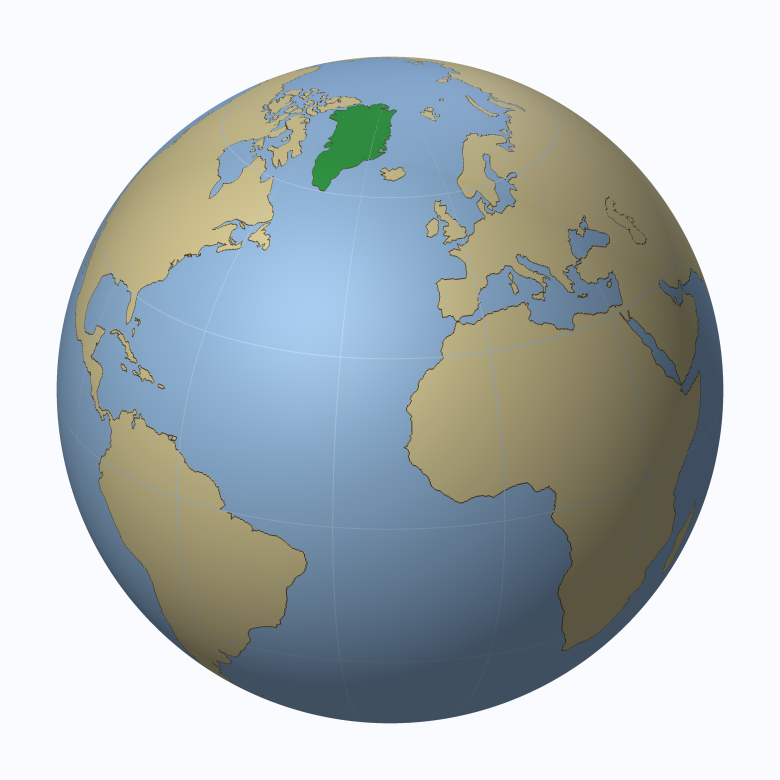 Greenland
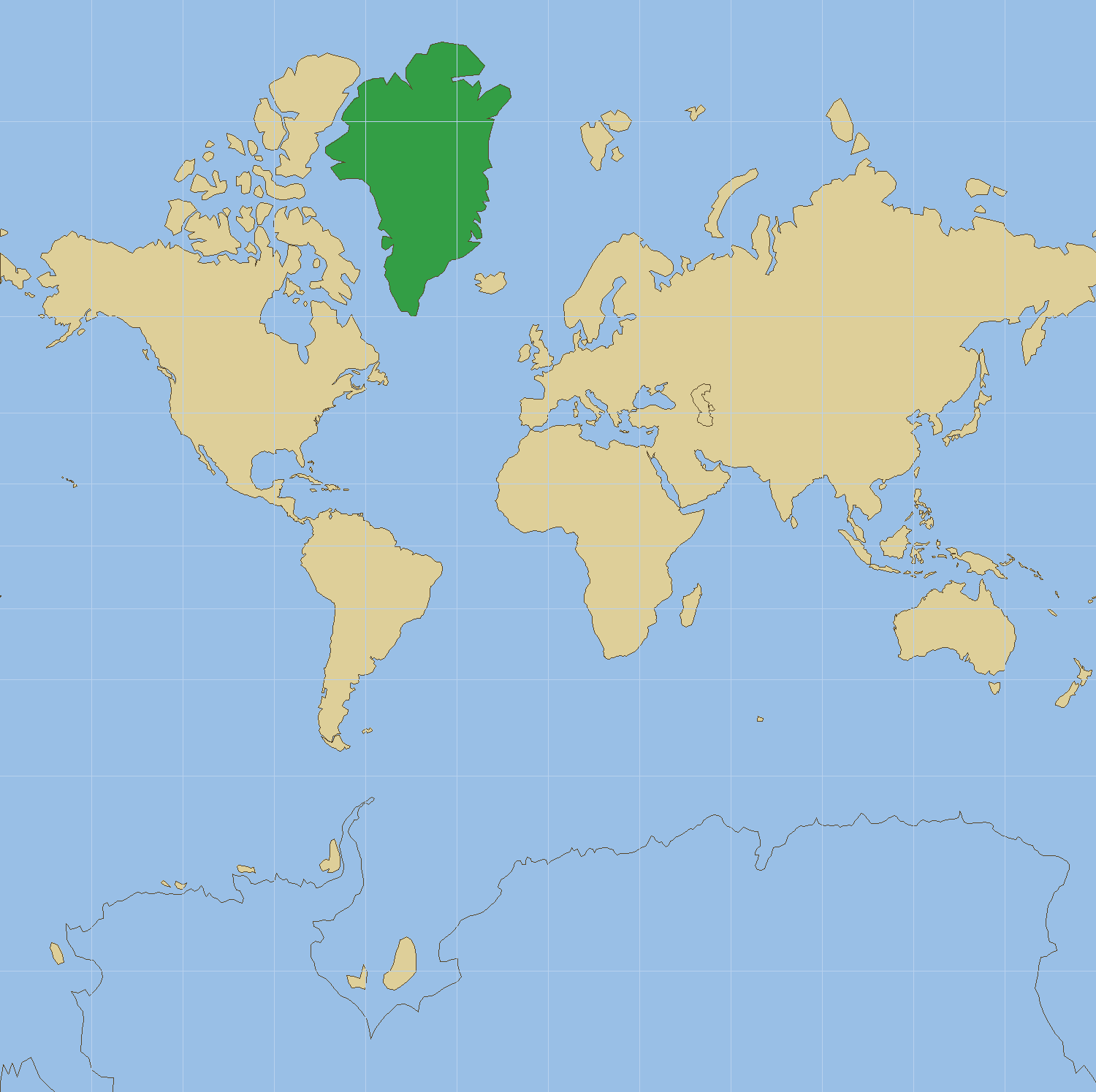 Greenland
Africa
Greenland
Africa
Mapmaking is, in short, the unavoidable art of choice: which distortion to tolerate, which correctness to keep. That an orange peel cannot be flattened, and that a world map is inevitably distorted, were both being said by one and the same piece of mathematics.
Quick note: why airplanes seem to take a detour
On a flat map, the flight path from Tokyo to New York looks like a big detour, arcing far to the north. But that is no detour; it is the shortest path on the sphere — a “straight line” along a great circle. Because it is the map that stretches and distorts the sphere, the true straight run appears bent. The “straight” of a curved world does not become a plain straight line on flat paper.
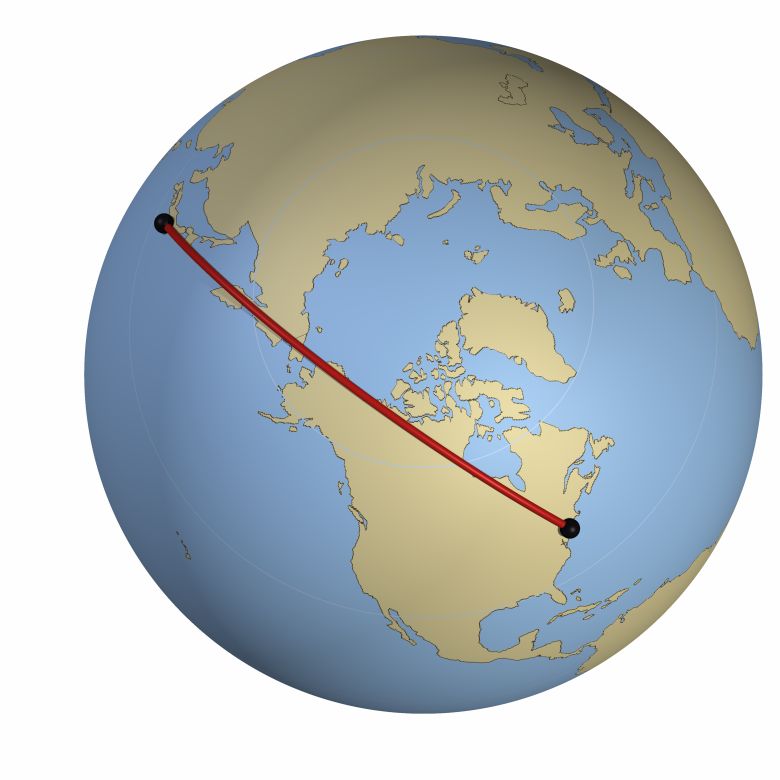 Tokyo
New York
✈
Tokyo
New York
✈
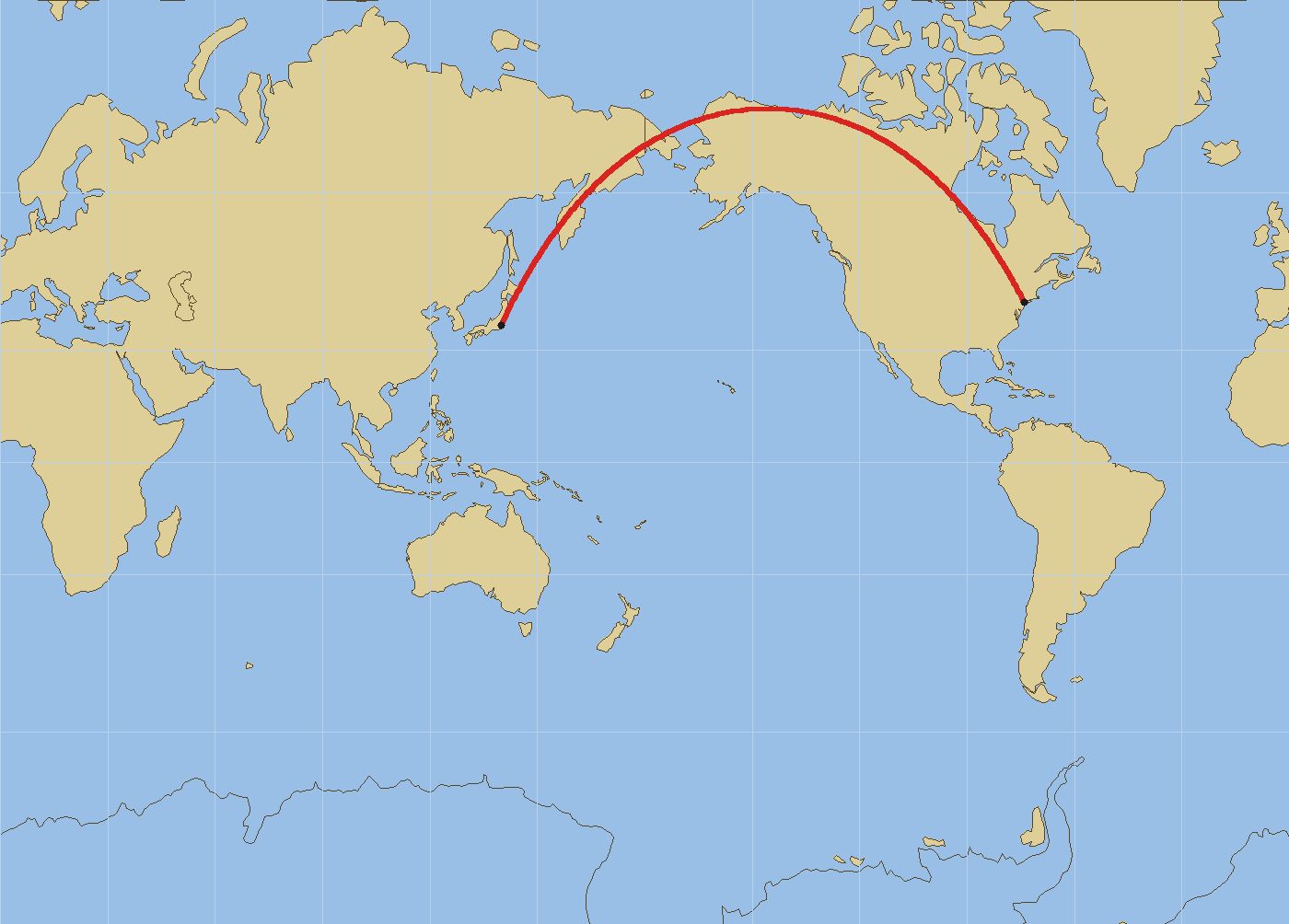 Tokyo
New York
✈
Tokyo
New York
✈
Closing — Toward the Geometry of the Inside Dweller
An orange peel will not lie flat. A world map is distorted. An airplane seems to take a detour. These wonders, seemingly unrelated, all flowed out of one fact: a surface has a true curvature determined by its inside alone. Gauss's Theorema Egregium remade curvature from something gazed at from outside into a property of the world measurable from within.
The idea that a surface's dweller can measure the shape of the world without looking outside is also the entrance to modern geometry, in which space itself can be curved. Those who wish to press on to the geometry of curved space — hyperbolic geometry, where infinitely many parallels can be drawn, or topology, which treats global shape — should head to Advanced. Those who would rather return to basics and work with their hands may rebuild from Beginner.
— The next time you peel an orange and notice that the skin simply will not lie flat, that is Gauss's Theorema Egregium, quietly at work in your hands.
Frequently Asked Questions
Why can't an orange peel or a sphere be spread flat without tearing?
Because a sphere has positive Gaussian curvature while a plane has zero Gaussian curvature. By Gauss's Theorema Egregium, Gaussian curvature is an intrinsic quantity that does not change when a surface is bent without stretching. Mapping a sphere onto a plane requires changing the curvature from positive to zero, which inevitably produces stretching or tearing. So an orange peel, however hard you try, cannot be flattened without tearing it or wrinkling it.
What does it mean that Gaussian curvature is “intrinsic”?
It means that Gaussian curvature is determined solely from lengths, angles, and areas measurable inside the surface, without looking at the surrounding space at all. A two-dimensional inhabitant living on the surface can learn how curved their world is just by measuring the angle sum of a triangle, or by comparing the circumference of a small circle against the value expected from its radius. This is the heart of Gauss's Theorema Egregium: curvature can be known from the inside, without gazing from outside.