Chapter 2: Surface Theory
Analyzing how a surface bends
Goal of this page
Understand the first fundamental form (length and angle) and the second fundamental form (bending). Define Gaussian curvature and mean curvature, and study the local properties of a surface.
1. Regular surfaces
A parametrized surface $\mathbf{r}(u, v): U \to \mathbb{R}^3$ is regular when
$$\mathbf{r}_u \times \mathbf{r}_v \neq 0,$$where $\mathbf{r}_u = \partial\mathbf{r}/\partial u$.
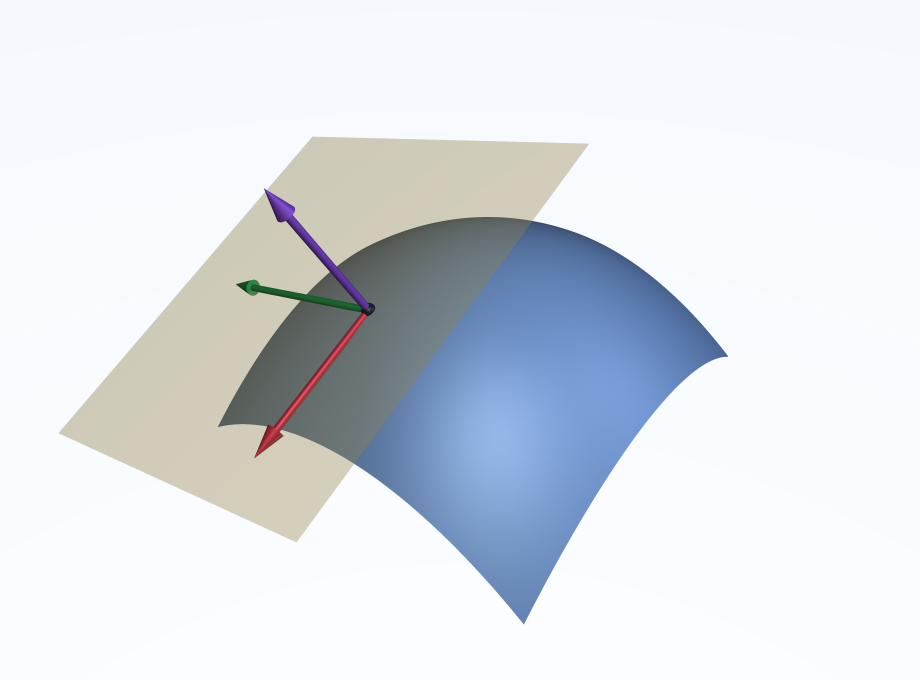
At each point $p=\mathbf{r}(u,v)$ the two partial derivatives $\mathbf{r}_u,\mathbf{r}_v$ span the tangent plane $T_pS$, and their cross product defines the unit normal $\mathbf{n}$, which is orthogonal to the tangent plane.
 $\mathbf{n}$
$\mathbf{r}_v$
$\mathbf{r}_u$
$p$
$T_pS$
$\mathbf{r}(u,v)$
$\mathbf{n}$
$\mathbf{r}_v$
$\mathbf{r}_u$
$p$
$T_pS$
$\mathbf{r}(u,v)$
2. First fundamental form
The metric (induced metric) that determines lengths, angles, and areas on the surface:
$$\mathrm{I} = ds^2 = E\,du^2 + 2F\,du\,dv + G\,dv^2,$$where
$$E = \mathbf{r}_u \cdot \mathbf{r}_u, \quad F = \mathbf{r}_u \cdot \mathbf{r}_v, \quad G = \mathbf{r}_v \cdot \mathbf{r}_v.$$- Arc length: $\displaystyle\int \sqrt{E\dot{u}^2 + 2F\dot{u}\dot{v} + G\dot{v}^2}\,dt$
- Angle between curves: $\cos\theta = \dfrac{E\dot{u}_1\dot{u}_2 + F(\dot{u}_1\dot{v}_2 + \dot{u}_2\dot{v}_1) + G\dot{v}_1\dot{v}_2}{\sqrt{E\dot{u}_1^2 + 2F\dot{u}_1\dot{v}_1 + G\dot{v}_1^2}\sqrt{E\dot{u}_2^2 + 2F\dot{u}_2\dot{v}_2 + G\dot{v}_2^2}}$
- Area: $\iint \sqrt{EG - F^2}\,du\,dv$
3. Second fundamental form
The quadratic form that expresses how the surface bends:
$$\mathrm{II} = L\,du^2 + 2M\,du\,dv + N\,dv^2,$$where
$$L = \mathbf{r}_{uu} \cdot \mathbf{n}, \quad M = \mathbf{r}_{uv} \cdot \mathbf{n}, \quad N = \mathbf{r}_{vv} \cdot \mathbf{n}.$$The geometric meaning of the second fundamental form is captured by the normal curvature. Cutting the surface at $p$ with the plane spanned by the unit normal $\mathbf{n}$ and a tangent direction $\mathbf{t}$ (the normal plane) produces a single curve at the intersection, the normal section curve. The curvature of this curve at $p$ is the normal curvature $\kappa_n$ in that direction.
Writing the tangent direction as $du:dv$, the normal curvature is the ratio of the two fundamental forms. This formula shows at a glance what the second fundamental form measures:
$$\kappa_n = \frac{\mathrm{II}}{\mathrm{I}} = \frac{L\,du^2 + 2M\,du\,dv + N\,dv^2}{E\,du^2 + 2F\,du\,dv + G\,dv^2}$$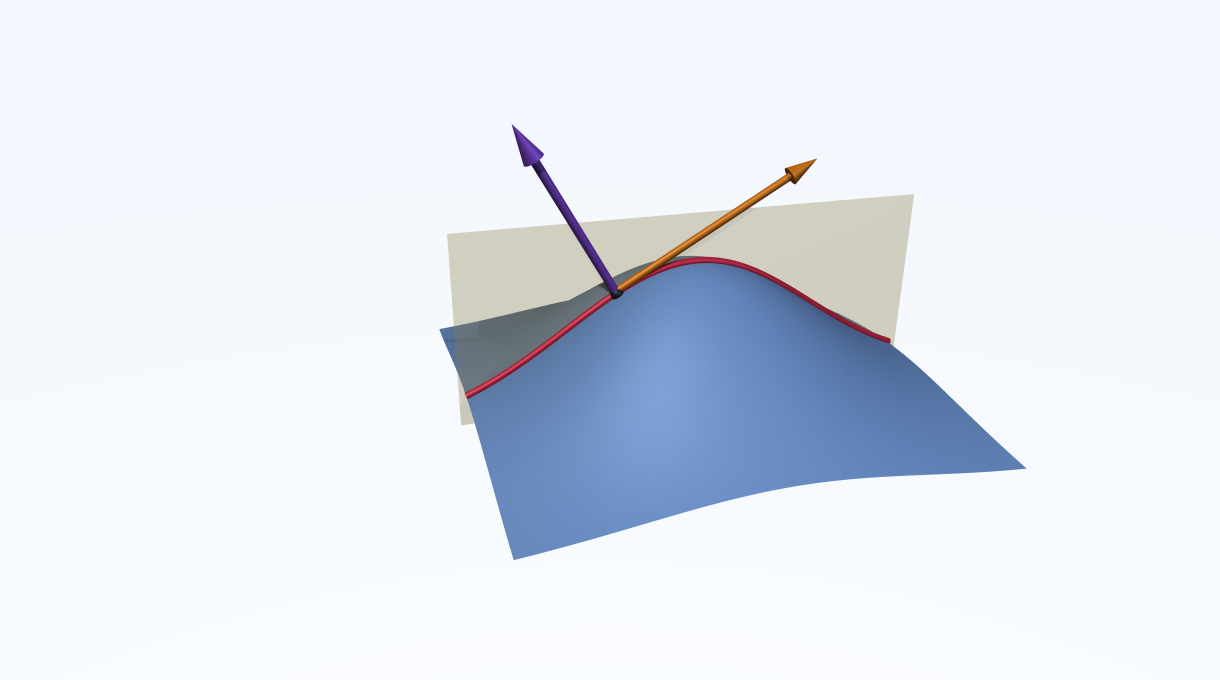 $\mathbf{n}$
$\mathbf{t}$
$p$
Normal plane
Normal section ($\kappa_n$)
$\mathbf{n}$
$\mathbf{t}$
$p$
Normal plane
Normal section ($\kappa_n$)
4. Principal curvatures and Gaussian curvature
At each point, the maximum and minimum of the normal curvature (bending in the normal direction) are the principal curvatures $\kappa_1, \kappa_2$.
They are the solutions of the eigenvalue problem
$$\det\begin{pmatrix} L - \kappa E & M - \kappa F \\ M - \kappa F & N - \kappa G \end{pmatrix} = 0.$$That is, the principal curvatures are the eigenvalues of the shape operator (Weingarten map) $S = \mathrm{I}^{-1}\,\mathrm{II}$, and the corresponding eigendirections are the principal directions.
- Gaussian curvature: $K = \kappa_1 \kappa_2 = \dfrac{LN - M^2}{EG - F^2}$
- Mean curvature: $H = \dfrac{\kappa_1 + \kappa_2}{2} = \dfrac{EN - 2FM + GL}{2(EG - F^2)}$
Here $E,F,G$ are the coefficients of the first fundamental form and $L,M,N$ those of the second fundamental form.
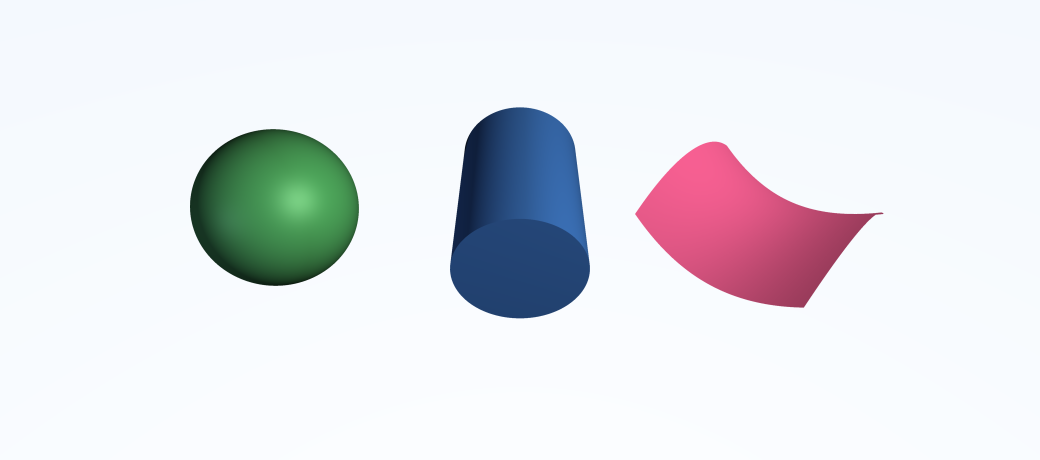
The sign of the Gaussian curvature $K=\kappa_1\kappa_2$ classifies which way the surface bends near a point. When the two principal curvatures have the same sign, $K>0$ (bowl-shaped); when one of them is $0$, $K=0$ (developable; intrinsically flat, though a cylinder is still curved in the ambient space); when they have opposite signs, $K<0$ (saddle-shaped).
 $K>0$
$K>0$Sphere $K=0$
Flat (cylinder) $K<0$
Saddle
The Gaussian curvature $K$ can be computed from the first fundamental form $E, F, G$ and its derivatives alone.
In other words, $K$ is an intrinsic quantity of the surface (it does not change when the surface is bent).
- Sphere of radius $R$: $K = 1/R^2$ (constant, positive)
- Plane: $K = 0$
- Cylinder: $K = 0$ (can be unrolled like a plane)
Summary
Key points of this chapter
- First fundamental form: measures length, angle, and area on the surface
- Second fundamental form: describes how the surface bends
- Gaussian curvature: $K = \kappa_1 \kappa_2$ (an intrinsic quantity)
- Theorema Egregium: $K$ is determined by the first fundamental form alone
Frequently asked questions
Q1. What does the first fundamental form measure?
The first fundamental form $\mathrm{I}=E\,du^2+2F\,du\,dv+G\,dv^2$ (with $E=\mathbf{r}_u\cdot\mathbf{r}_u$, $F=\mathbf{r}_u\cdot\mathbf{r}_v$, $G=\mathbf{r}_v\cdot\mathbf{r}_v$) is the metric that measures arc length, angles, and area intrinsically on the surface. It is the two-dimensional version of a Riemannian metric, and the intrinsic geometry of the surface, independent of how it is embedded in the ambient space, is determined by the first fundamental form alone.
Q2. What is the geometric meaning of the second fundamental form?
The second fundamental form $\mathrm{II}=L\,du^2+2M\,du\,dv+N\,dv^2$ (with $L=\mathbf{r}_{uu}\cdot\mathbf{n}$, and so on) describes how the surface bends inside the ambient space (usually $\mathbb{R}^3$). Cutting the surface with the normal plane spanned by the unit normal $\mathbf{n}$ and a tangent direction produces a normal section curve whose curvature is the normal curvature $\kappa_n$, given as the ratio of the second to the first fundamental form. The principal curvatures are the maximum and minimum of this ratio.
Q3. What does the Theorema Egregium state?
Gauss's Theorema Egregium states that the Gaussian curvature $K=\kappa_1\kappa_2$ can be computed from the first fundamental form $E,F,G$ and its derivatives alone. Hence $K$ is an intrinsic quantity that does not change when the surface is bent without stretching. It follows that a sphere ($K=1/R^2>0$) cannot be flattened onto a plane ($K=0$) without distortion, which is also why every flat world map must contain distortion.
References
- M. P. do Carmo, Differential Geometry of Curves and Surfaces, Prentice-Hall, 1976.
- A. Pressley, Elementary Differential Geometry, 2nd ed., Springer, 2010.
- Wikipedia: First fundamental form
- Wikipedia: Second fundamental form
- Wikipedia: Gaussian curvature
- Wikipedia: Theorema Egregium