Chapter 1: Parametric Curves
Curve Definitions, Regular Curves, and Reparametrization
Introduction (first- to second-year university)
Introduction
In differential geometry, curves are expressed using a "parameter." Choosing a value of a single variable (the parameter) determines one point on the curve, so the properties of the curve can be studied using the tools of calculus.
Definition of a Curve
Definition: Parametric Curve
A smooth map from an interval $I \subset \mathbb{R}$ to $\mathbb{R}^n$ ($n \geq 2$),
$$\gamma: I \to \mathbb{R}^n, \quad t \mapsto \gamma(t) = (\gamma_1(t), \gamma_2(t), \ldots, \gamma_n(t))$$is called a parametric curve. Here "smooth" means of class $C^\infty$ (continuously differentiable any number of times). We take $I$ to be an open interval; when a closed interval $[a, b]$ is used, one-sided derivatives are taken at the endpoints. In differential geometry, the cases $n = 2$ (plane curves) and $n = 3$ (space curves) are most commonly studied.
![A parametric curve: a point t in the interval [a, b] corresponds to a point γ(t) on the curve, with the tangent vector γ'(t) drawn](fig-parametric-curve.svg)
Figure 1: A parametric curve — each point $t$ in the interval $[a, b]$ corresponds to a point $\gamma(t)$ on the curve. The red arrow represents the tangent vector $\gamma'(t)$.
Examples: Circle, Parabola, and Helix
Example 1: Unit Circle
$$\gamma(t) = (\cos t, \sin t), \quad t \in [0, 2\pi]$$The parameter $t$ corresponds to the angle (in radians).
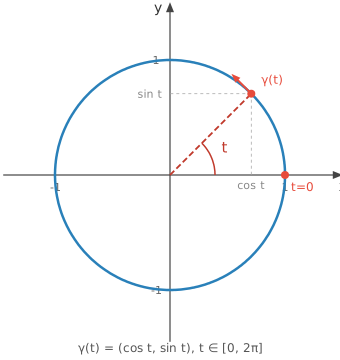
Figure 2: Parametric representation of the unit circle — the parameter $t$ corresponds to the angle, and the point $\gamma(t)$ moves counterclockwise around the circle.
Example 2: Parabola
$$\gamma(t) = (t, t^2), \quad t \in \mathbb{R}$$This is a parametric representation of the graph $y = x^2$.
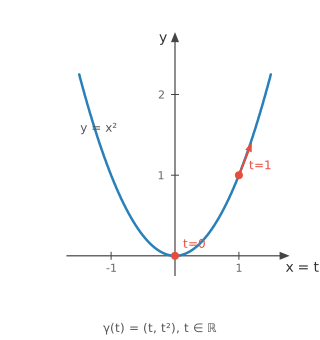
Figure 3: Parametric representation of the parabola — the graph $y = x^2$ is expressed as $\gamma(t) = (t, t^2)$. The red arrow shows the tangent vector $\gamma'(1) = (1, 2)$ at $t = 1$.
Example 3: Helix
$$\gamma(t) = (a\cos t, a\sin t, bt), \quad t \in \mathbb{R}$$For $a > 0$ and $b \neq 0$, this represents a helix winding around a cylinder. It rises as $t$ increases if $b > 0$ and descends if $b \lt 0$.
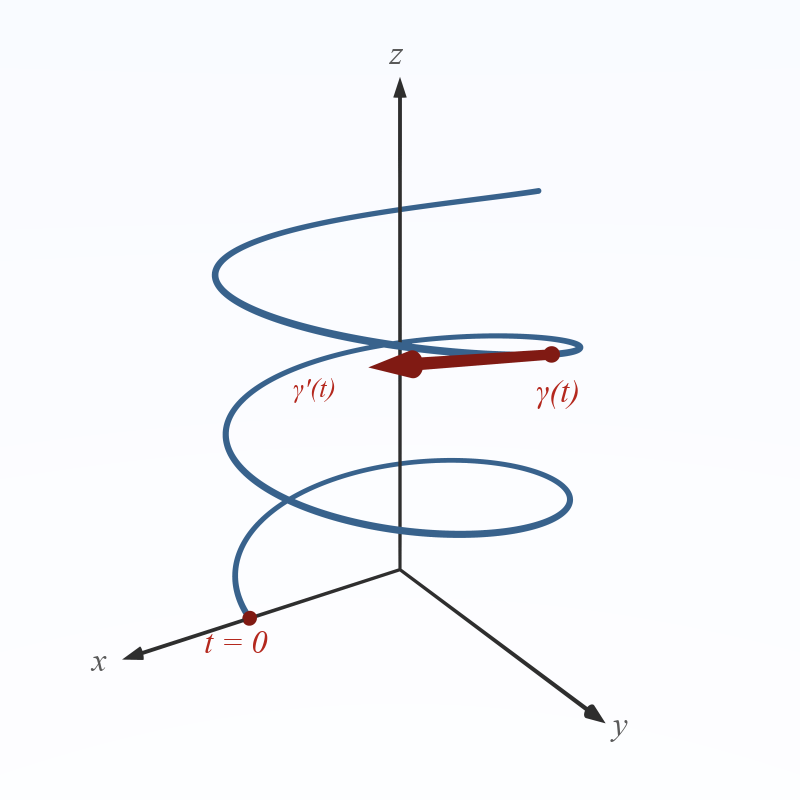
Figure 4: Helix — for $b > 0$, the spiral curve $\gamma(t) = (a\cos t, a\sin t, bt)$ rises around the $z$-axis (it descends if $b \lt 0$). The red arrow represents the tangent vector $\gamma'(t)$.
Regular Curves
Definition: Regular Curve
A parametric curve $\gamma: I \to \mathbb{R}^n$ is said to be regular if for all $t \in I$,
$$\gamma'(t) \neq \mathbf{0}$$The vector $\gamma'(t)$ is called the velocity vector. (What the discussion of regularity needs is only that $\gamma$ be of class $C^1$ (at least once continuously differentiable), and the same definition is used for $C^1$ curves.)
The heart of regularity is the condition $\gamma'(t) \neq \mathbf{0}$. Smoothness (differentiability) alone does not rule out cusps: the example $\gamma(t) = (t^3, t^2)$ below is of class $C^\infty$ yet has a cusp at the origin. Imposing $\gamma'(t) \neq \mathbf{0}$ rules out cusps and stationary points, so the tangent direction is uniquely determined at each parameter value $t$.
All three examples of the previous section are regular. For the unit circle, $\gamma'(t) = (-\sin t, \cos t)$ and $|\gamma'(t)| = 1$; for the parabola, $\gamma'(t) = (1, 2t)$ and $|\gamma'(t)| = \sqrt{1 + 4t^2} \geq 1$; for the helix, $\gamma'(t) = (-a\sin t, a\cos t, b)$ and $|\gamma'(t)| = \sqrt{a^2 + b^2} > 0$ (a constant).
Meaning of the Velocity Vector
When $\gamma'(t) \neq \mathbf{0}$, the vector $\gamma'(t) = \left(\dfrac{d\gamma_1}{dt}, \dfrac{d\gamma_2}{dt}, \ldots, \dfrac{d\gamma_n}{dt}\right)$ represents the tangent direction of the curve at parameter $t$ (where $\gamma'(t) = \mathbf{0}$ it gives no direction). If the parameter $t$ is interpreted as time, then $\gamma'(t)$ corresponds to the velocity of a particle, and regularity means "the particle is always in motion."
Example: A Non-Regular Curve
$$\gamma(t) = (t^3, t^2), \quad t \in \mathbb{R}$$Since $\gamma'(t) = (3t^2, 2t)$, we have $\gamma'(0) = (0, 0)$ at $t = 0$. Therefore the curve is not regular at $t = 0$.
This curve has a cusp at the origin.
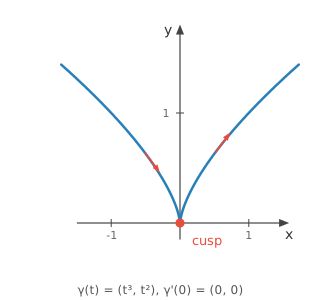
Figure 5: A non-regular curve $\gamma(t) = (t^3, t^2)$ — the curve has a cusp at the origin. At $t = 0$, $\gamma'(0) = \mathbf{0}$, so the velocity vector gives no tangent direction.
Reparametrization
The same curve can be expressed using different parameters.
Definition: Reparametrization
Take a smooth bijection $\phi: J \to I$ from an interval $J$ onto $I$ with $\phi'(s) \neq 0$ for all $s \in J$. Then $\tilde{\gamma} = \gamma \circ \phi$ is called a reparametrization of $\gamma$.
$$\tilde{\gamma}(s) = \gamma(\phi(s))$$For example, given the unit circle $\gamma(t) = (\cos t, \sin t)$ ($t \in (0, 2\pi)$), setting $\phi(s) = s^2$ on $J = (0, \sqrt{2\pi})$ yields
$$\tilde{\gamma}(s) = \gamma(s^2) = (\cos s^2, \sin s^2)$$which traces the same circle but at a different speed. While $\gamma$ traverses the circle at constant speed, $\tilde{\gamma}$ moves slowly when $s$ is small and accelerates as $s$ increases. Geometrically it is the same curve, but the "rate of traversal" differs. (Since $\phi'(s) = 2s$ vanishes only at $s = 0$, any interval not containing $s = 0$ will do. Taking $J = (-\sqrt{2\pi}, 0)$ also gives a reparametrization, this time with the orientation reversed.)
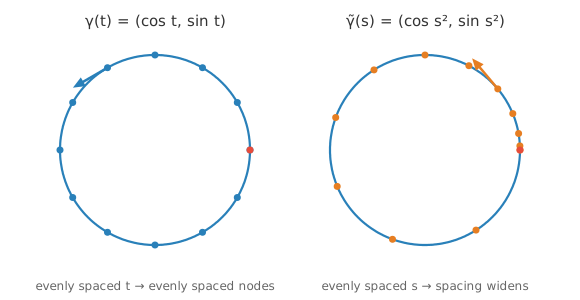
Figure 6: Comparison of reparametrizations — the same unit circle traversed with parameter $t$ (left) and with the parameter $s$ of the reparametrization by $\phi(s) = s^2$ (right). Evenly spaced values of $t$ produce evenly spaced nodes on the circle, whereas evenly spaced values of $s$ cluster nodes near the starting point, with spacing increasing along the way.
Proposition: Velocity under Reparametrization
If $\tilde{\gamma} = \gamma \circ \phi$, then by the chain rule,
$$\tilde{\gamma}'(s) = \gamma'(\phi(s)) \cdot \phi'(s)$$Therefore, if $\gamma$ is regular and $\phi'(s) \neq 0$ for all $s \in J$, then $\tilde{\gamma}$ is also regular.
When $\phi' > 0$, the reparametrization is said to be "orientation-preserving"; when $\phi' < 0$, it is "orientation-reversing."
Summary
- In this article, a parametric curve is defined as a smooth map from an interval into a space (the curve as a figure is its image).
- A regular curve is one whose velocity vector is nonzero at every parameter value ($C^1$ or smoother).
- The same curve can be expressed with different parameters (reparametrization).
- In differential geometry, regular curves are the fundamental objects of study.
References
Frequently Asked Questions
Q1: What is a parametric curve?
A smooth map $\gamma: I \to \mathbb{R}^n$ from an interval $I$ to $\mathbb{R}^n$ ($n \geq 2$). As the parameter $t$ varies, $\gamma(t)$ traces out a curve in space. It can also handle curves that are hard to write in the form $y = f(x)$, such as circles, self-intersecting curves, and closed curves. In differential geometry, plane curves ($n = 2$) and space curves ($n = 3$) are the most commonly studied.
Q2: What is a regular curve?
A parametric curve whose velocity vector $\gamma'(t)$ is nonzero at every parameter value $t$ ($C^1$ or smoother). Regularity makes the tangent direction uniquely determined at each parameter value and rules out cusps and stationary points. Smoothness is an assumption of the definition, not a consequence of regularity ($\gamma(t) = (t^3, t^2)$ is smooth but not regular).
Q3: What is reparametrization?
Replacing the parameter of a curve by means of a smooth bijection $\phi: J \to I$ with $\phi'(s) \neq 0$ for all $s$, giving the new parametric curve $\tilde{\gamma}(s) = \gamma(\phi(s))$. Geometrically the same curve is traversed, but the rate of traversal (the speed) changes. If $\phi' > 0$ the orientation is preserved; if $\phi' \lt 0$ it is reversed.