Differential Geometry
Differential Geometry
What is Differential Geometry?
Differential geometry is a branch of mathematics that studies geometric objects such as curves, surfaces, and manifolds using the tools of calculus. In physics, it serves as the mathematical foundation of general relativity and plays a central role in modern theoretical physics and geometric analysis.
Objects of Differential Geometry
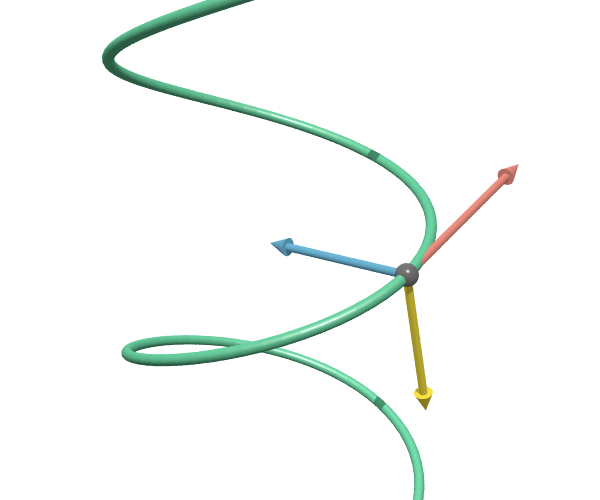
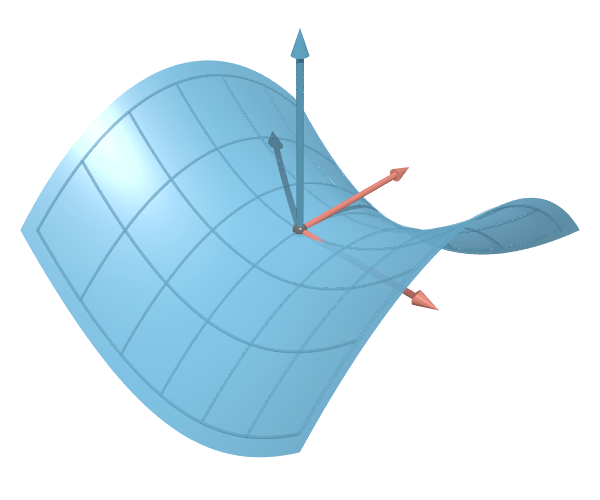
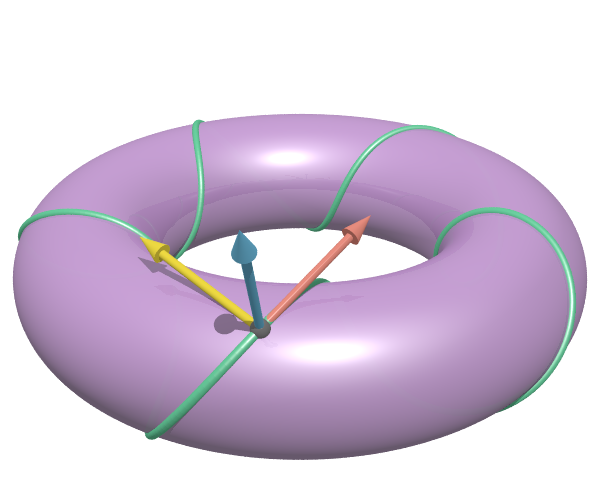
Differential geometry studies the properties of "curved spaces"
Generalizing from curves → surfaces → manifolds
Mathematical foundation for general relativity, gauge theory, and geometric analysis
This series provides a systematic study in four stages, from the classical theory of curves and surfaces to manifolds and Riemannian geometry.
Content by Level
Introductory
Differential Geometry of Curves
- Parametric curves
- Arc length parameter
- Curvature and radius of curvature
- Theory of plane curves
- Space curves and torsion
- Frenet-Serret formulas
Basic
Differential Geometry of Surfaces
- Parametric surfaces
- First fundamental form
- Second fundamental form
- Gaussian and mean curvature
- Geodesics
- Theorema Egregium
Intermediate
Manifold Theory
- Topological and differentiable manifolds
- Tangent and cotangent spaces
- Vector fields and flows
- Differential forms
- Exterior derivative and de Rham cohomology
- Stokes' theorem
Advanced
Riemannian Geometry
- Riemannian metric
- Levi-Civita connection
- Geodesics and exponential map
- Curvature tensor
- Jacobi fields
- Comparison theorems
Overview
Key Formulas and Concepts
Curvature (Plane Curve)
$$\kappa = \dfrac{|x'y'' - x''y'|}{(x'^2 + y'^2)^{3/2}}$$
Frenet-Serret Formulas
$$\dfrac{d\mathbf{T}}{ds} = \kappa\mathbf{N}$$
$$\dfrac{d\mathbf{N}}{ds} = -\kappa\mathbf{T} + \tau\mathbf{B}$$
First Fundamental Form
$$ds^2 = E\,du^2 + 2F\,du\,dv + G\,dv^2$$
Gaussian Curvature
$$K = \kappa_1 \kappa_2 = \dfrac{LN - M^2}{EG - F^2}$$
Geodesic Equation
$$\dfrac{d^2x^k}{dt^2} + \Gamma^k_{ij}\dfrac{dx^i}{dt}\dfrac{dx^j}{dt} = 0$$
Riemann Curvature Tensor
$$R^l_{ijk} = \partial_j\Gamma^l_{ik} - \partial_k\Gamma^l_{ij} + \cdots$$
Prerequisites
- Introductory: Calculus (especially multivariable differentiation), basic linear algebra
- Basic: Introductory content, partial derivatives, basic vector calculus
- Intermediate: Basic content, basic point-set topology, linear algebra (dual spaces)
- Advanced: Intermediate content, tensor algebra, theory of differential forms