Proofs Chapter 6: Position Vector Identities
Identities (45)-(57) involving the position vector $\mathbf{r}$
6. Position Vector Identities
This chapter proves identities (45)-(57) for the position vector $\mathbf{r} = (x, y, z)$, its magnitude $r = |\mathbf{r}| = \sqrt{x^2 + y^2 + z^2}$, and the radial unit vector $\hat{\mathbf{r}} = \mathbf{r}/r$. These results pervade physics: Coulomb's law in electrostatics, Newtonian gravity, and the Green function of the 3D Laplace equation. In particular, identities (52) and (53) feature the Dirac delta $\delta^3(\mathbf{r})$, which encodes point sources mathematically.
Unless stated otherwise, all formulas are valid for $r \neq 0$.
Chapter Roadmap
- 6.1 First-order derivatives (45–50): $\nabla r$, $\nabla \cdot \mathbf{r}$, $\nabla \times \mathbf{r}$, $\nabla(1/r)$, $\nabla r^2$, $\nabla r^n$
- 6.2 Divergence (51–52): $\nabla \cdot (r^n \mathbf{r})$ and the Dirac delta result $\nabla \cdot (\mathbf{r}/r^3) = 4\pi \delta^3(\mathbf{r})$
- 6.3 Laplacian (53–55): $\nabla^2(1/r)$ (Green function), $\nabla^2 r^n$, $\nabla^2 \ln r$
- 6.4 $(\mathbf{A} \cdot \nabla)$ on the position vector (56–57): $(\mathbf{A} \cdot \nabla)\mathbf{r}$, $(\mathbf{A} \cdot \nabla)r$
6.1 First-Order Derivatives
(45) Gradient of the radial distance
Proof
Differentiate $r = \sqrt{x_1^2 + x_2^2 + x_3^2}$ with respect to each $x_i$ via the chain rule.
\begin{equation}\dfrac{\partial r}{\partial x_i} = \dfrac{\partial}{\partial x_i}\!\left( \displaystyle\sum_{j=1}^{3} x_j^2 \right)^{1/2} = \dfrac{1}{2r} \cdot 2 x_i = \dfrac{x_i}{r} \label{eq:6-45-1}\end{equation}
Collecting components from $\eqref{eq:6-45-1}$ into vector form,
\begin{equation}\nabla r = \left( \dfrac{x}{r}, \dfrac{y}{r}, \dfrac{z}{r} \right) = \dfrac{\mathbf{r}}{r} = \hat{\mathbf{r}} \label{eq:6-45-2}\end{equation}
(46) Divergence of the position vector
Proof
By definition of divergence, sum the partial derivatives of each component.
\begin{equation}\nabla \cdot \mathbf{r} = \dfrac{\partial x}{\partial x} + \dfrac{\partial y}{\partial y} + \dfrac{\partial z}{\partial z} = 1 + 1 + 1 = 3 \label{eq:6-46-1}\end{equation}
(47) Curl of the position vector
Proof
Express the $i$-th component of the curl using the Levi-Civita symbol $\varepsilon_{ijk}$.
\begin{equation}[\nabla \times \mathbf{r}]_i = \displaystyle\sum_{j,k} \varepsilon_{ijk} \dfrac{\partial x_k}{\partial x_j} = \displaystyle\sum_{j,k} \varepsilon_{ijk} \delta_{kj} \label{eq:6-47-1}\end{equation}
The Kronecker delta $\delta_{kj}$ in $\eqref{eq:6-47-1}$ leaves only $k = j$ terms, but $\varepsilon_{ijj} = 0$ because the Levi-Civita symbol is antisymmetric and vanishes on repeated indices. Hence
\begin{equation}[\nabla \times \mathbf{r}]_i = \displaystyle\sum_{j} \varepsilon_{ijj} = 0 \label{eq:6-47-2}\end{equation}
This holds for every $i$, so $\nabla \times \mathbf{r} = \mathbf{0}$.
(48) Gradient of $1/r$
Proof
Set $f(g) = 1/g$ with $g = r$ and apply the chain rule (identity (17)). Since $f'(g) = -1/g^2$,
\begin{equation}\nabla\!\left( \dfrac{1}{r} \right) = -\dfrac{1}{r^2} \nabla r \label{eq:6-48-1}\end{equation}
Substituting $\nabla r = \mathbf{r}/r$ from (45) into $\eqref{eq:6-48-1}$,
\begin{equation}\nabla\!\left( \dfrac{1}{r} \right) = -\dfrac{1}{r^2} \cdot \dfrac{\mathbf{r}}{r} = -\dfrac{\mathbf{r}}{r^3} \label{eq:6-48-2}\end{equation}
(49) Gradient of $r^2$
Proof
Expand $r^2 = x^2 + y^2 + z^2$ directly and differentiate component-wise.
\begin{equation}\dfrac{\partial r^2}{\partial x_i} = \dfrac{\partial}{\partial x_i}\!\left( \displaystyle\sum_{j=1}^{3} x_j^2 \right) = 2 x_i \label{eq:6-49-1}\end{equation}
Assembling $\eqref{eq:6-49-1}$ into vector form,
\begin{equation}\nabla r^2 = (2x, 2y, 2z) = 2\mathbf{r} \label{eq:6-49-2}\end{equation}
(50) Gradient of $r^n$
Proof
Apply the chain rule (identity (18)) to $f(r) = r^n$. Since $f'(r) = n r^{n-1}$,
\begin{equation}\nabla r^n = n r^{n-1} \nabla r \label{eq:6-50-1}\end{equation}
Substituting $\nabla r = \mathbf{r}/r$ from (45) into $\eqref{eq:6-50-1}$,
\begin{equation}\nabla r^n = n r^{n-1} \cdot \dfrac{\mathbf{r}}{r} = n r^{n-2} \mathbf{r} \label{eq:6-50-2}\end{equation}
Using $\hat{\mathbf{r}} = \mathbf{r}/r$, expression $\eqref{eq:6-50-2}$ also reads
\begin{equation}\nabla r^n = n r^{n-1} \hat{\mathbf{r}} \label{eq:6-50-3}\end{equation}
6.2 Divergence
(51) Divergence of $r^n \mathbf{r}$
Proof
Apply the product rule for divergence (identity (23))
\begin{equation}\nabla \cdot (\phi \mathbf{A}) = \phi (\nabla \cdot \mathbf{A}) + \mathbf{A} \cdot \nabla \phi \label{eq:6-51-1}\end{equation}
with $\phi = r^n$ and $\mathbf{A} = \mathbf{r}$:
\begin{equation}\nabla \cdot (r^n \mathbf{r}) = r^n (\nabla \cdot \mathbf{r}) + \mathbf{r} \cdot \nabla r^n \label{eq:6-51-2}\end{equation}
Substituting $\nabla \cdot \mathbf{r} = 3$ from (46) and $\nabla r^n = n r^{n-2} \mathbf{r}$ from (50) into $\eqref{eq:6-51-2}$,
\begin{equation}\nabla \cdot (r^n \mathbf{r}) = 3 r^n + \mathbf{r} \cdot (n r^{n-2} \mathbf{r}) = 3 r^n + n r^{n-2} (\mathbf{r} \cdot \mathbf{r}) \label{eq:6-51-3}\end{equation}
Using $\mathbf{r} \cdot \mathbf{r} = r^2$ in $\eqref{eq:6-51-3}$,
\begin{equation}\nabla \cdot (r^n \mathbf{r}) = 3 r^n + n r^{n-2} \cdot r^2 = (3 + n) r^n = (n + 3) r^n \label{eq:6-51-4}\end{equation}
(52) Divergence with Dirac delta
Proof
The proof has three stages. Since $\mathbf{r}/r^3$ is undefined at the origin, the divergence theorem cannot be applied directly to a region containing it; we therefore work on a region that avoids the origin and conclude in the sense of distributions.
Stage 1 (vanishing for $r \neq 0$):
Setting $n = -3$ in (51) yields, for $r \neq 0$,
\begin{equation}\nabla \cdot \!\left( \dfrac{\mathbf{r}}{r^3} \right) = \nabla \cdot (r^{-3} \mathbf{r}) = (-3 + 3) r^{-3} = 0 \label{eq:6-52-1}\end{equation}
so the divergence vanishes everywhere except possibly at the origin.
Step 2 (computing the flux while avoiding the singularity):
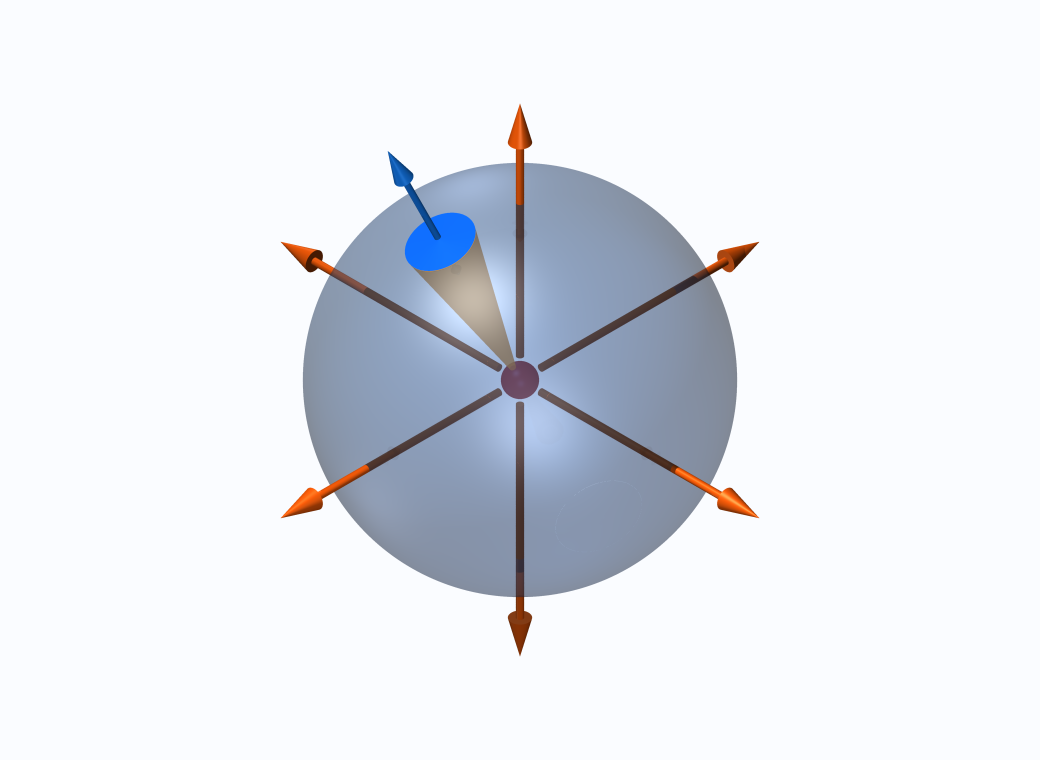
Since $\mathbf{r}/r^3$ is undefined at the origin, the divergence theorem cannot be applied directly to a ball containing it. Instead, fix $0 < \varepsilon < R$ and work on the spherical shell $\Omega_\varepsilon = B_R \setminus \overline{B_\varepsilon}$. There the field is $C^1$ and its divergence vanishes identically by $\eqref{eq:6-52-1}$, so the divergence theorem gives
\begin{equation}0 = \displaystyle\int_{\Omega_\varepsilon} \nabla \cdot \!\left( \dfrac{\mathbf{r}}{r^3} \right) dV = \displaystyle\oint_{\partial B_R} \dfrac{\mathbf{r}}{r^3} \cdot d\mathbf{S} - \displaystyle\oint_{\partial B_\varepsilon} \dfrac{\mathbf{r}}{r^3} \cdot d\mathbf{S} \label{eq:6-52-2}\end{equation}
The boundary of $\Omega_\varepsilon$ consists of the outer sphere $\partial B_R$ and the inner sphere $\partial B_\varepsilon$; on the inner sphere the outward normal of $\Omega_\varepsilon$ is $-\hat{\mathbf{r}}$, which flips the sign and produces the second term. In other words, the inner and outer fluxes coincide.
Now compute the flux through a sphere of radius $a$. There $\mathbf{r} = a \hat{\mathbf{r}}$ and the outward surface element is $d\mathbf{S} = a^2 \hat{\mathbf{r}}\, d\Omega$ ($d\Omega$ being the solid-angle element), so
\begin{equation}\dfrac{\mathbf{r}}{r^3} \cdot d\mathbf{S} = \dfrac{a \hat{\mathbf{r}}}{a^3} \cdot (a^2 \hat{\mathbf{r}}\, d\Omega) = \hat{\mathbf{r}} \cdot \hat{\mathbf{r}}\, d\Omega = d\Omega \label{eq:6-52-3}\end{equation}
Integrating over the whole sphere,
\begin{equation}\displaystyle\oint_{\partial B_a} \dfrac{\mathbf{r}}{r^3} \cdot d\mathbf{S} = \displaystyle\oint_{\partial B_a} d\Omega = 4\pi \qquad (a > 0) \label{eq:6-52-4}\end{equation}
Thus the flux taken with the outward normal equals the full solid angle and is the constant $4\pi$, independent of the radius $a$ (consistent with the equality of the inner and outer fluxes in $\eqref{eq:6-52-2}$). With the inward normal the sign flips to $-4\pi$.
Step 3 (conclusion in the sense of distributions):
Away from the origin the divergence vanishes, yet the outward flux through every sphere centred at the origin equals $4\pi$. This behaviour — zero for $r \neq 0$, all the contribution at the origin — is exactly that of a delta function. Rigorously, for every test function $\varphi \in C_c^\infty(\mathbb{R}^3)$ the definition of the distributional divergence gives
\begin{equation}\left\langle \nabla \cdot \dfrac{\mathbf{r}}{r^3},\ \varphi \right\rangle = -\displaystyle\int_{\mathbb{R}^3} \dfrac{\mathbf{r}}{r^3} \cdot \nabla\varphi\, dV = -\lim_{\varepsilon \to 0} \displaystyle\int_{r > \varepsilon} \dfrac{\mathbf{r}}{r^3} \cdot \nabla\varphi\, dV = 4\pi\,\varphi(\mathbf{0}) \label{eq:6-52-5}\end{equation}
(on $r > \varepsilon$ the field is $C^1$, so one may integrate by parts; the volume term vanishes by $\eqref{eq:6-52-1}$ and the boundary term equals $4\pi\varphi(\mathbf{0})$ by $\eqref{eq:6-52-4}$). The right-hand side is precisely the action of $4\pi\,\delta^3$ on the test function, hence
\begin{equation}\nabla \cdot \!\left( \dfrac{\mathbf{r}}{r^3} \right) = 4\pi\,\delta^3(\mathbf{r}) \label{eq:6-52-6}\end{equation}
For a bounded region $V$ with piecewise smooth boundary, the outward flux is $4\pi$ if the origin lies in the interior of $V$ and $0$ if the origin lies outside $\overline{V}$ (the case of the origin on the boundary requires separate treatment).
6.3 Laplacian
(53) Laplacian of $1/r$ (Green function of the Laplace equation)
Proof
Write the Laplacian as the divergence of the gradient and apply (48) and (52) in turn.
\begin{equation}\nabla^2\!\left( \dfrac{1}{r} \right) = \nabla \cdot \nabla\!\left( \dfrac{1}{r} \right) \label{eq:6-53-1}\end{equation}
Substituting $\nabla(1/r) = -\mathbf{r}/r^3$ from (48) into $\eqref{eq:6-53-1}$,
\begin{equation}\nabla^2\!\left( \dfrac{1}{r} \right) = \nabla \cdot \!\left( -\dfrac{\mathbf{r}}{r^3} \right) = -\nabla \cdot \!\left( \dfrac{\mathbf{r}}{r^3} \right) \label{eq:6-53-2}\end{equation}
Substituting $\nabla \cdot (\mathbf{r}/r^3) = 4\pi \delta^3(\mathbf{r})$ from (52) into $\eqref{eq:6-53-2}$,
\begin{equation}\nabla^2\!\left( \dfrac{1}{r} \right) = -4\pi\,\delta^3(\mathbf{r}) \label{eq:6-53-3}\end{equation}
(54) Laplacian of $r^n$
Proof
Express the Laplacian as the divergence of the gradient and apply (50) and (51) in turn.
\begin{equation}\nabla^2 r^n = \nabla \cdot \nabla r^n \label{eq:6-54-1}\end{equation}
Substituting $\nabla r^n = n r^{n-2} \mathbf{r}$ from (50) into $\eqref{eq:6-54-1}$,
\begin{equation}\nabla^2 r^n = \nabla \cdot (n r^{n-2} \mathbf{r}) = n\, \nabla \cdot (r^{n-2} \mathbf{r}) \label{eq:6-54-2}\end{equation}
Apply (51) with exponent $n - 2$. Since $\nabla \cdot (r^{n-2} \mathbf{r}) = ((n - 2) + 3) r^{n-2} = (n + 1) r^{n-2}$,
\begin{equation}\nabla^2 r^n = n \cdot (n + 1) r^{n-2} = n(n+1) r^{n-2} \label{eq:6-54-3}\end{equation}
(55) Laplacian of $\ln r$
Proof
Compute $\nabla \ln r$ via the chain rule.
\begin{equation}\nabla \ln r = \dfrac{1}{r} \nabla r = \dfrac{1}{r} \cdot \dfrac{\mathbf{r}}{r} = \dfrac{\mathbf{r}}{r^2} \label{eq:6-55-1}\end{equation}
Take the divergence of $\eqref{eq:6-55-1}$ using (51). Rewriting $\mathbf{r}/r^2 = r^{-2} \mathbf{r}$ and applying $n = -2$,
\begin{equation}\nabla^2 \ln r = \nabla \cdot \!\left( \dfrac{\mathbf{r}}{r^2} \right) = ((-2) + 3) r^{-2} = \dfrac{1}{r^2} \label{eq:6-55-2}\end{equation}
6.4 $(\mathbf{A} \cdot \nabla)$ on the Position Vector
(56) $(\mathbf{A} \cdot \nabla)\mathbf{r} = \mathbf{A}$
Proof
Apply $(\mathbf{A} \cdot \nabla) = \displaystyle\sum_j A_j \dfrac{\partial}{\partial x_j}$ to the $i$-th component $x_i$ of $\mathbf{r}$.
\begin{equation}[(\mathbf{A} \cdot \nabla)\mathbf{r}]_i = \displaystyle\sum_j A_j \dfrac{\partial x_i}{\partial x_j} = \displaystyle\sum_j A_j \delta_{ij} = A_i \label{eq:6-56-1}\end{equation}
Since $\eqref{eq:6-56-1}$ holds for every $i$,
\begin{equation}(\mathbf{A} \cdot \nabla)\mathbf{r} = \mathbf{A} \label{eq:6-56-2}\end{equation}
(57) $(\mathbf{A} \cdot \nabla)r$
Proof
Expand $(\mathbf{A} \cdot \nabla)r$ in components.
\begin{equation}(\mathbf{A} \cdot \nabla)r = \displaystyle\sum_j A_j \dfrac{\partial r}{\partial x_j} \label{eq:6-57-1}\end{equation}
Substituting $\partial r / \partial x_j = x_j / r$ from $\eqref{eq:6-45-1}$ into $\eqref{eq:6-57-1}$,
\begin{equation}(\mathbf{A} \cdot \nabla)r = \displaystyle\sum_j A_j \cdot \dfrac{x_j}{r} = \dfrac{1}{r} \displaystyle\sum_j A_j x_j = \dfrac{\mathbf{A} \cdot \mathbf{r}}{r} \label{eq:6-57-2}\end{equation}
References
- Jackson, J. D. (1998). Classical Electrodynamics (3rd ed.). Wiley. (Sec. 1.4: Dirac delta function and Poisson equation)
- Griffiths, D. J. (2017). Introduction to Electrodynamics (4th ed.). Cambridge University Press. (Sec. 1.5: vector calculus identities and Coulomb's law)
- Arfken, G. B., Weber, H. J., & Harris, F. E. (2013). Mathematical Methods for Physicists (7th ed.). Academic Press. (Ch. 3: Vector analysis; Ch. 9: Green functions)
- Vector calculus identities - Wikipedia
- Laplace operator - Wikipedia
Frequently Asked Questions
Why is ∇·(r/r³) equal to 4πδ³(r) and not zero?
It vanishes for $r \neq 0$, but the origin carries a singularity. Computing the flux through a sphere of radius $R$ with the outward normal gives a surface integral of $4\pi$ (the full solid angle), independent of $R$. The divergence must therefore be a delta function concentrated at the origin. This is the mathematical core of Coulomb's law and Newtonian gravity.
How is ∇²(1/r) related to the Green function?
Since $\nabla^2(1/r) = -4\pi\delta^3(\mathbf{r})$, the function $G(\mathbf{r}) = -1/(4\pi r)$ is the fundamental solution (Green function) of the three-dimensional Laplacian under the convention $\Delta G = \delta^3$. This justifies the Poisson equation solution $\varphi(\mathbf{r}) = (1/4\pi\varepsilon_0)\int \rho(\mathbf{r}')/|\mathbf{r}-\mathbf{r}'|\,d^3r'$.
How should one interpret (A·∇)r = A for the position vector?
The directional derivative along $\mathbf{A}$ applied to the position vector $\mathbf{r}$ (bold) returns $\mathbf{A}$ itself. Geometrically, $\mathbf{r}$ is the identity map, so moving in any direction changes it by exactly that direction vector. Do not confuse it with the scalar version $(\mathbf{A}\cdot\nabla)r = (\mathbf{A}\cdot\mathbf{r})/r$, where $r$ (italic) is the radial distance.