Volume $\tfrac{4}{3}\pi r^3$ and Surface Area $4\pi r^2$ of a Sphere
Volume and Surface Area of a Sphere — a proof without calculus
Introduction (high-school level)
Goal of this page
Prove that a sphere has volume $\tfrac{4}{3}\pi r^3$ and surface area $4\pi r^2$ without using integration (via Cavalieri's principle and Archimedes' hat-box theorem), and understand why a limit is even harder to avoid in three dimensions.
1. What we are proving
Like the area of a circle, a sphere's volume $\tfrac43\pi r^3$ and surface area $4\pi r^2$ can be derived without computing an integral (though, as we will see, the idea of a limit itself is unavoidable and essential). Archimedes proved them in the third century BC in On the Sphere and Cylinder, and he was proudest of this result (he is said to have had a sphere-in-a-cylinder carved on his tomb).
As with the circle, we adopt the same convention: define $\pi$ as the ratio of circumference to diameter, $\pi = C/(2r)$, and derive the values from there. The point is how to measure a solid bounded by a curved surface.
2. Volume: Cavalieri's principle
The tool is Cavalieri's principle: if two solids, sliced by parallel planes over the same range of heights, have cross-sections of equal area at every height, then the two solids have equal volume. Intuitively, a volume is a stack of thin slabs; if the slabs at every height have the same area (hence, at the same thickness, the same volume), then the totals stacked up are equal too.
Slicing a hemisphere (radius $r$, flat face down at $y=0$, top at $y=r$) at height $y$ ($0\le y\le r$) gives a disk of radius $\sqrt{r^2-y^2}$, area $\pi(r^2-y^2)$. Compare this with "a cylinder of radius $r$ and height $r$, with a cone of the same base and height removed." Slicing that solid at height $y$ gives a disk of radius $r$ minus a disk of radius $y$ — an annulus of area $\pi r^2-\pi y^2=\pi(r^2-y^2)$.
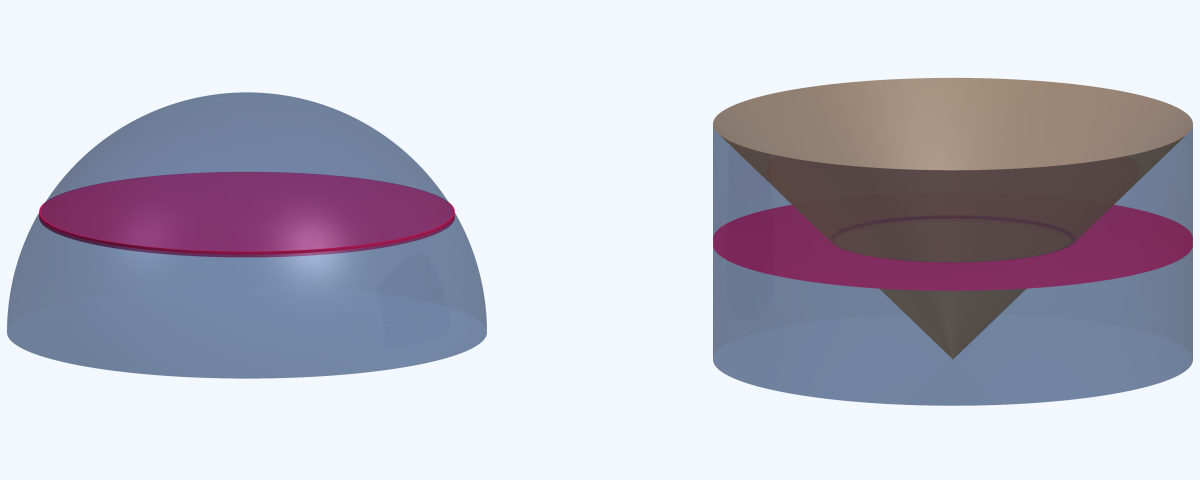
Equal cross-sectional area at every height → by Cavalieri's principle the hemisphere has the same volume as "cylinder − cone." Only the cylinder and cone volumes remain:
$$V_{\text{hemisphere}} = V_{\text{cylinder}} - V_{\text{cone}} = \pi r^2\cdot r - \tfrac13\pi r^2\cdot r = \tfrac23\pi r^3.$$
Therefore $$V_{\text{sphere}} = 2\times \tfrac23\pi r^3 = \frac{4}{3}\pi r^3.$$
This is Archimedes' famous result, "the sphere is $\tfrac23$ of its circumscribing cylinder" (the cylinder's volume is $\pi r^2\cdot 2r=2\pi r^3$, and $\tfrac23$ of it is $\tfrac43\pi r^3$).
The cone volume $\tfrac13\pi r^2 h$ we used hides a subtlety: for general pyramids its factor $\tfrac13$ cannot be obtained by finite cut-and-paste alone (see Section 6 (b)). A limit is already lurking at this step.
3. Surface area: Archimedes' hat-box theorem
Consider the cylinder circumscribing the sphere (radius $r$, height $2r$). Here is the remarkable fact Archimedes saw.
Archimedes' hat-box theorem
The area of a zone cut from the sphere by two horizontal planes equals the area of the band those two planes cut from the circumscribing cylinder. If the two planes are a height $h$ apart, both have area $$2\pi r\,h.$$
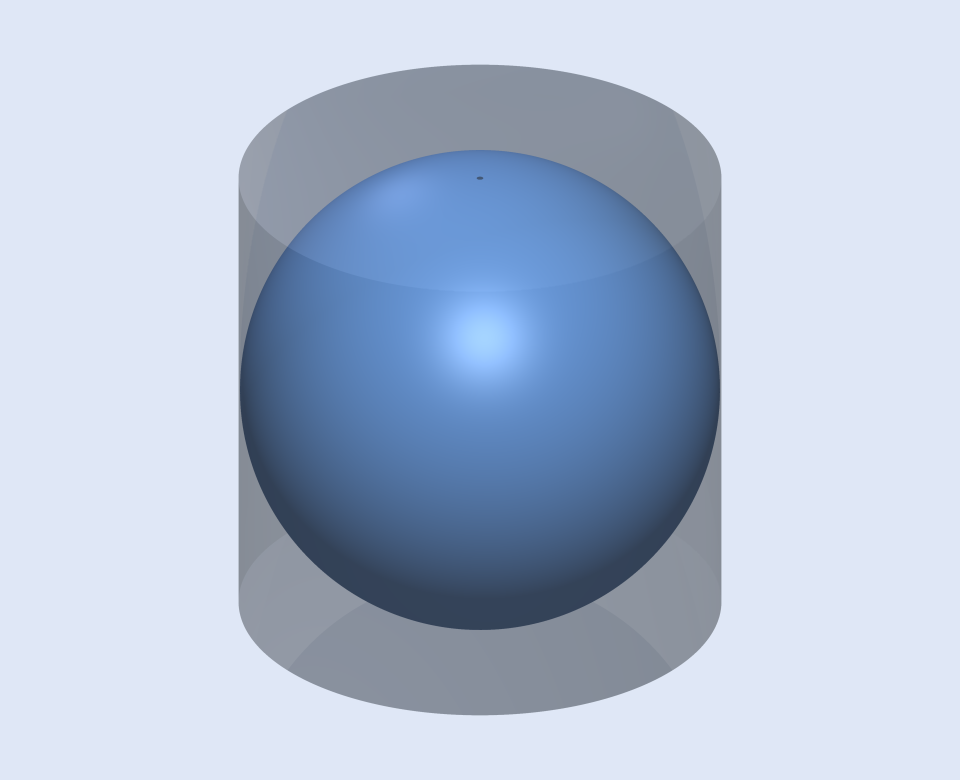
Why does it hold on the sphere? At height $y$ the parallel circle has radius $\rho=\sqrt{r^2-y^2}$ and circumference $2\pi\rho$. But the band on the sphere is slanted, so for a small height increase $\Delta y$ its width along the surface is longer than $\Delta y$, approximately $\dfrac{r}{\rho}\,\Delta y$ (an approximation, since $\rho$ changes slightly across the band). This $\dfrac{r}{\rho}$ comes from the right triangle (hypotenuse $r$, horizontal leg $\rho$) formed by the centre, the surface point, and the axis: since the sphere's tangent is perpendicular to the radius, the band is tilted from the vertical by an angle $\varphi$ with $\cos\varphi=\rho/r$, so for a vertical rise $\Delta y$ the slant width is $\dfrac{\Delta y}{\cos\varphi}=\dfrac{r}{\rho}\,\Delta y$. Hence the band area is
$$2\pi\rho \times \frac{r}{\rho}\,\Delta y = 2\pi r\,\Delta y.$$
That is, the shrinking of the circumference (proportional to $\rho$) and the stretching of the slant (proportional to $\tfrac{r}{\rho}$) cancel exactly, so the area of a thin band is approximately $2\pi r\,\Delta y$ regardless of the height $y$. Cutting into ever finer bands and adding them up (a limit) gives exactly $2\pi r\,h$ for a band of height $h$ ($dS = 2\pi r\,dy$ for an infinitesimal band). This equals the band of the same height on the circumscribing cylinder (constant radius $r$, so area $2\pi r\,\Delta y$).
The whole sphere is the sum of bands from height $-r$ to $r$, so
$$S_{\text{sphere}} = 2\pi r\cdot 2r = 4\pi r^2 = 4\times(\text{area of a great circle, }\pi r^2).$$
4. Parallel with the circle: $A=\tfrac12 rC$ and $V=\tfrac13 rS$
For the area of a circle, Archimedes' result was "area $=\tfrac12 r\cdot C$" ($C$ the circumference). For the sphere the corresponding statement is
$$V_{\text{sphere}} = \tfrac13\,r\,S_{\text{sphere}} = \tfrac13\,r\cdot 4\pi r^2 = \tfrac43\pi r^3.$$
The $\tfrac12$ in two dimensions simply becomes $\tfrac13$ in three; both have the same form, "volume $=\tfrac13\times$ radius $\times$ surface area" (on a sphere every surface point is at distance $r$ from the centre, so splitting the surface into small pieces and adding up the thin cones of volume $\tfrac13 r\,\Delta S$ with apex at the centre gives the same structure as the cone-volume formula; it is not a formula for general solids). Circle and sphere hang on the same skeleton.
5. How Archimedes himself proved it
Our proof used Cavalieri's principle, but Cavalieri lived in the 17th century — roughly $1900$ years after Archimedes (3rd century BC). Archimedes himself used a different method, keeping discovery and proof separate.
① Discovery: weighing on a balance (The Method)
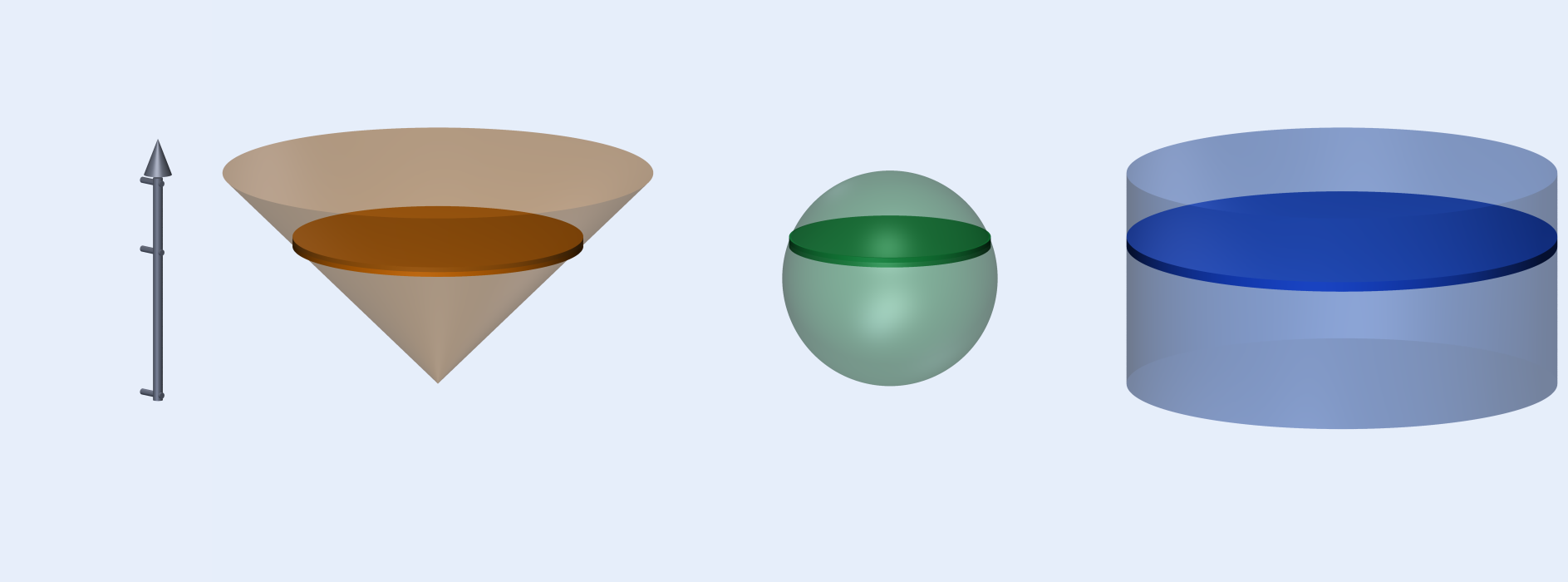
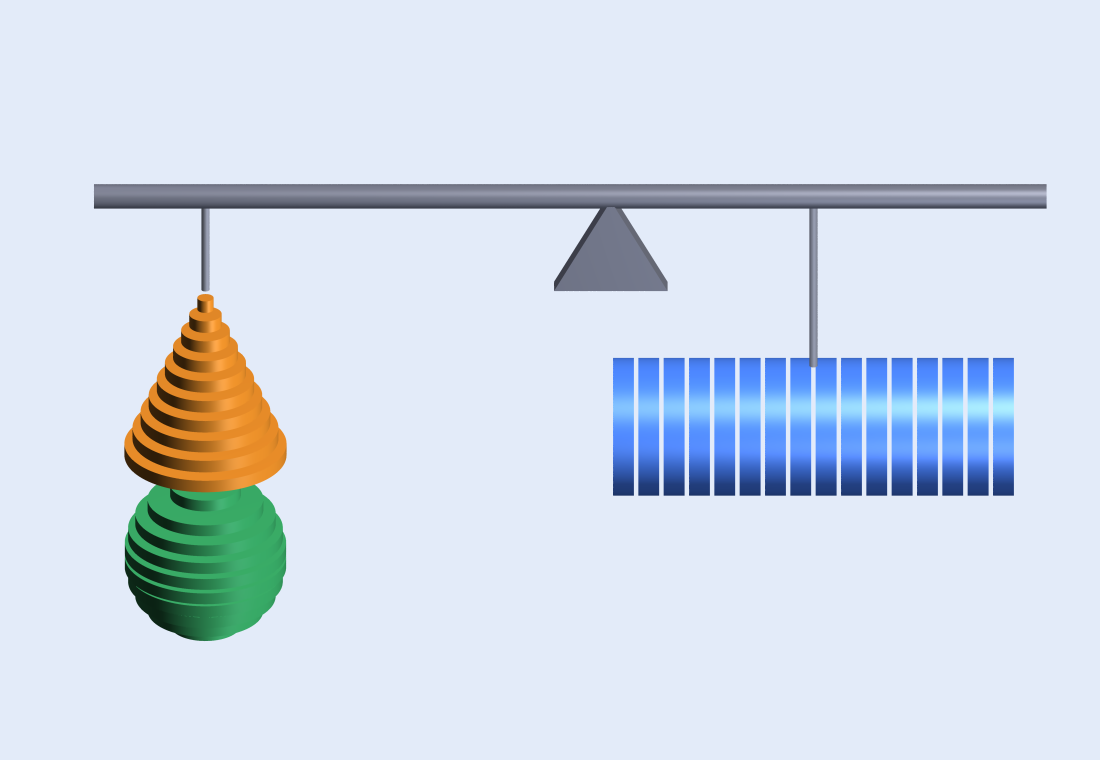
Archimedes first discovered the volume using a balance (an unequal-arm steelyard governed by the law of the lever). He cut the sphere, cone, and cylinder into thin slabs (thickness $\Delta x$) and balanced the cross-sections about the fulcrum. Since both slabs have the same thickness $\Delta x$, it cancels when comparing moments, so the balance is decided by cross-sectional area alone. Line up the three solids on a common axis and let $x$ be the position along it ($x=0$ at the bottom face of the cylinder, $x=2r$ at its top face, so $0\le x\le 2r$). At position $x$ the cross-sectional area is $\pi x^2$ for the cone (apex at $x=0$), $\pi x(2r-x)$ for the sphere (diameter $2r$), and $4\pi r^2$ for the cylinder (radius $2r$) (Fig 3).
 $x{=}2r$
$x$
$x{=}0$
$\pi x^2$
$\pi x(2r-x)$
$4\pi r^2$
$x{=}2r$
$x$
$x{=}0$
$\pi x^2$
$\pi x(2r-x)$
$4\pi r^2$
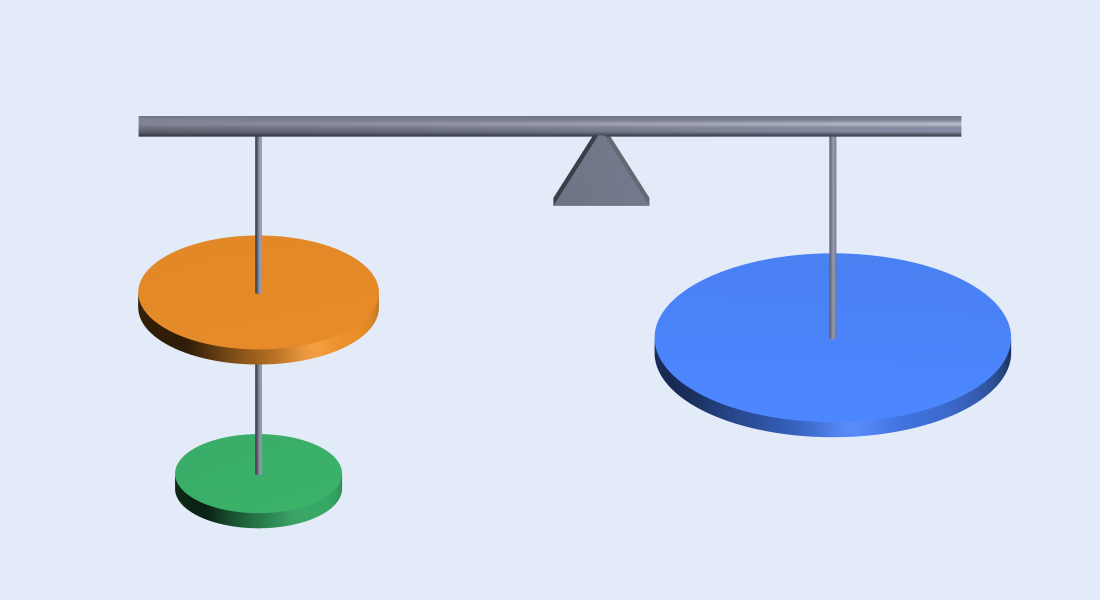
Now put the axis on a balance with $x=0$ at the fulcrum. Then the cylinder slice at position $x$ sits at lever arm $x$. Moving the "sphere slice + cone slice" at the same position $x$ to lever arm $2r$ exactly balances that cylinder slice (Fig 4):
$$\pi\bigl[x(2r-x)+x^2\bigr]\cdot 2r = \pi(2rx)\cdot 2r = 4\pi r^2\cdot x.$$
 $2r$
$x$
$\pi x^2$
$\pi x(2r{-}x)$
$4\pi r^2$
$2r$
$x$
$\pi x^2$
$\pi x(2r{-}x)$
$4\pi r^2$
Now sum the per-position balance over all slices. The key is that the two sides are handled asymmetrically. On the left, every sphere-slice-plus-cone-slice is carried to a single point on the far side of the fulcrum (distance $2r$), so we may simply add the areas: it is as if the entire sphere and cone hang at distance $2r$ (moment $=2r\,(V_{\text{sphere}}+V_{\text{cone}})$). On the right, the cylinder slices are left in place, each at its own position $x$, so the whole cylinder is equivalent to its entire volume $V_{\text{cylinder}}$ concentrated at its centroid. And because the cylinder has a constant cross-section — it is uniform along its length — that centroid sits exactly at the midpoint, distance $r$ (moment $=r\,V_{\text{cylinder}}$). This position-weighted sum $\sum x\cdot(\text{cylinder slice})\,\Delta x$ over slabs of thickness $\Delta x$ (which tends to $r\,V_{\text{cylinder}}$ as the slabs get thinner) is exactly where the integral hides, and Archimedes sidesteps it using the known geometric fact that a uniform cylinder's centroid is at its midpoint. (Here the cylinder has radius $2r$ and height $2r$, so $V_{\text{cylinder}}=8\pi r^3$, and the cone has base radius $2r$ and height $2r$, so $V_{\text{cone}}=\tfrac83\pi r^3$ — larger than the auxiliary solids of Section 2.) Balancing the two moments,
$$2r\,(V_{\text{sphere}}+V_{\text{cone}}) = r\,V_{\text{cylinder}} \;\Rightarrow\; V_{\text{sphere}}+V_{\text{cone}}=\tfrac12 V_{\text{cylinder}} \;\Rightarrow\; V_{\text{sphere}}=4\pi r^3-\tfrac{8}{3}\pi r^3=\tfrac43\pi r^3.$$
 $2r$
$r$
$2r$
$r$
He had, in effect, "performed the integration with a balance." Yet Archimedes himself stated plainly that, because it uses a limit of infinitely thin slabs (indivisibles) and physics (the lever), this is a means of discovery, not a proof.
② Proof: the method of exhaustion (On the Sphere and Cylinder)
The rigorous proof is the same method of exhaustion (double reductio ad absurdum) as for the area of a circle. One squeezes the sphere between inscribed and circumscribed solids of revolution—the solids obtained by rotating a regular polygon about a diameter, i.e. stacks of cones and conical frustums.
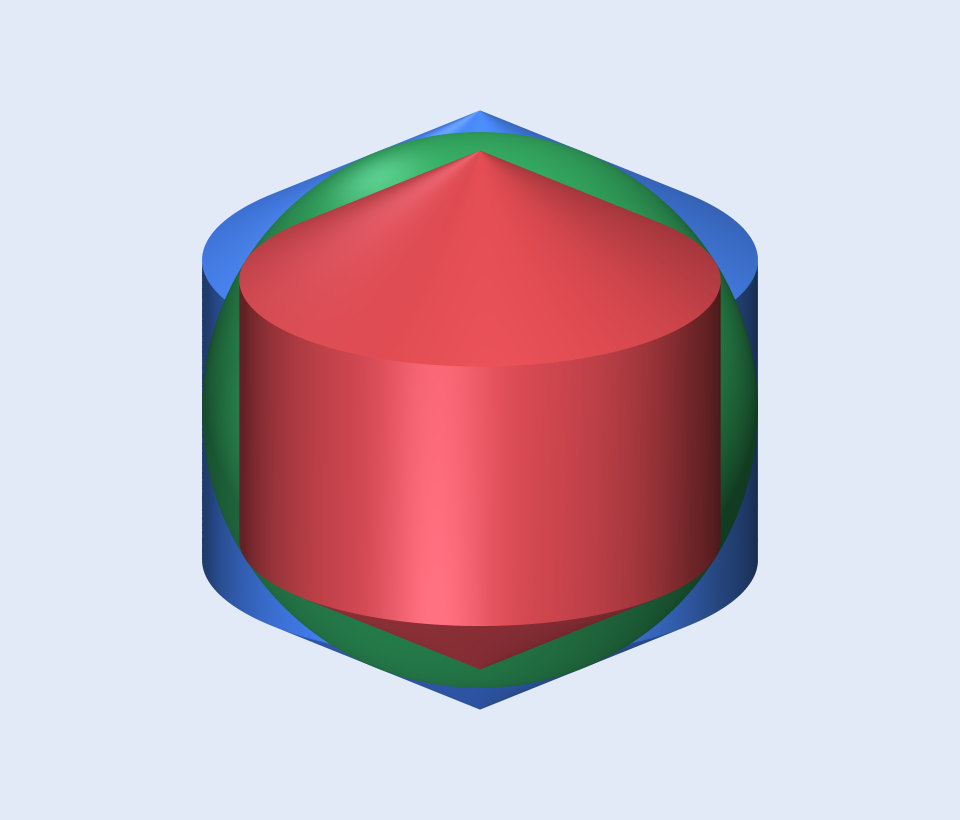
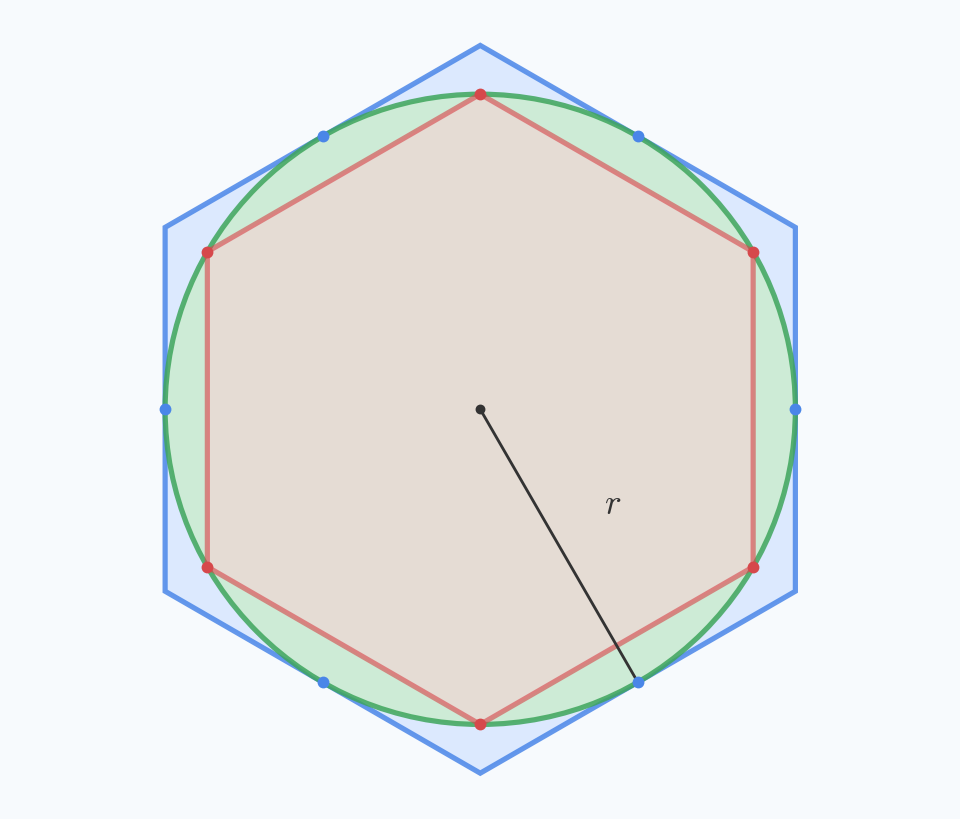
The lateral areas and volumes of cones and frustums (cylinders) can be computed exactly, using no curved surfaces. With these we run the very same double reductio ad absurdum as for the area of a circle.
Double reductio ad absurdum (the heart of exhaustion)
Let the sphere's volume be $V$ and the target $T = \tfrac43\pi r^3$ (four times the cone whose base is a great circle and whose height is $r$). The inscribed and circumscribed solids are built from cones and frustums (including cylinders) alone, so their volumes are exact, and one can show $V_{\text{in}} < T < V_{\text{out}}$ always (by computing the cone and frustum volumes). Moreover, increasing the number of sides makes $V_{\text{out}} - V_{\text{in}}$ as small as we please, so both approach the sphere ($V_{\text{in}} \to V$, $V_{\text{out}} \to V$).
- Assume $V > T$: since $V_{\text{in}} \to V$, some inscribed solid would have $V_{\text{in}} > T$. But always $V_{\text{in}} < T$ — a contradiction.
- Assume $V < T$: likewise some circumscribed solid would have $V_{\text{out}} < T$. But always $V_{\text{out}} > T$ — a contradiction.
Both the "greater" and the "lesser" assumption fail, so $V = T = \tfrac43\pi r^3$. $\blacksquare$ (The surface area $4\pi r^2$ follows from the same double reductio applied to lateral areas.)
This yields Proposition I.33, "the surface of a sphere $=$ four times its great circle $=4\pi r^2$," and Proposition I.34, "the sphere $=$ four times the cone whose base is a great circle and whose height is the radius $=\tfrac43\pi r^3$." As a corollary, sphere : circumscribing cylinder $=2:3$ — the figure Archimedes had carved on his tomb.
A historical aside: the lost and rediscovered Method
The Method of ① (a letter to Eratosthenes) was lost for a long time and was rediscovered by Heiberg in 1906 in the "Archimedes Palimpsest." Until then people knew only the rigorous proof of ②, and how he had arrived at the answers was a lasting mystery. The balancing-of-slices idea of ① lives on in Cavalieri's principle (1635) — which drops the balance and asserts "equal cross-sectional areas imply equal volumes" — and later in integration. Our proof is the modern descendant of that idea.
6. Why a limit is even harder to avoid in 3D
As with the circle, integration can be avoided but a limit cannot. And in three dimensions the barrier appears one level deeper than for the circle.
(This section goes a little beyond high-school mathematics. Readers who only want the formulas and their proofs may skip to the Summary.)
(a) Cavalieri's principle is itself a limit
Stacking cross-sections along the height (the method of indivisibles), when justified in modern terms, amounts to accumulating thin slices — a limit. The same is true of the "$\Delta y$ band" in the hat-box theorem.
Aside: how does Cavalieri's principle differ from (Riemann) integration?
Riemann integration is a tool that produces the numerical value of the volume by cutting the cross-sectional area $A(y)$ into thin slabs, summing them, and taking a limit: $V=\displaystyle\lim_{n\to\infty}\sum_i A(y_i)\,\Delta y=\int_a^b A(y)\,dy$. Cavalieri's principle, by contrast, merely compares and concludes that if two solids have equal cross-sectional area at every height then their volumes are equal ($A_1(y)=A_2(y)\Rightarrow V_1=V_2$); it computes no value.
- Goal: Cavalieri shows two volumes are equal (relative); Riemann produces the value of a volume (absolute).
- Input needed: Cavalieri needs only that the cross-sections are equal, plus a known reference solid to compare with (no formula for $A(y)$ required); Riemann needs the area function $A(y)$ and its integral.
- The limit: Riemann makes the limit $\sum\to\int$ explicit; Cavalieri keeps it out of sight, but it is still there.
In fact Cavalieri's principle is a corollary of integration (more precisely of Fubini's theorem): the volume of a (measurable) solid equals the integral of its cross-sectional area, $V=\int A(y)\,dy$, so $A_1=A_2$ immediately gives $V_1=V_2$. It is not a rival method, just one particular use of the integral. Historically Cavalieri's "indivisibles" ($1635$) were an intuitive forerunner of the integral, and Riemann ($1854$) and Darboux ($1875$) made the limit rigorous.
This is exactly why, in the sphere's proof, the "computation" $\int A(y)\,dy$ can be avoided — it suffices to see that the cross-sections match — while the limit that justifies "stacking slices gives the volume" cannot. That is the point of this section.
(b) The pyramid's $\tfrac13$ cannot in general come from finite dissection
The volume proof used the cone (pyramid) volume $\tfrac13\times$ base $\times$ height. But for general pyramids this $\tfrac13$ cannot be obtained by finite cut-and-paste alone (it can in special cases, such as cutting a cube into three congruent square pyramids, but not, for example, for a regular tetrahedron; a cone, having a curved surface, is not a polyhedron to begin with). In two dimensions any two polygons of equal area are scissors-congruent (the Bolyai–Gerwien theorem), but in three dimensions this fails.
Going deeper: Hilbert's third problem (the Dehn invariant)
"Can any two polyhedra of equal volume always be cut into finitely many pieces and reassembled into one another?" — this is Hilbert's third problem (1900), settled the same year by his student Dehn in the negative. A regular tetrahedron is not scissors-congruent to any cube of equal volume (the "Dehn invariant," a quantity preserved under cut-and-paste, differs between them). So proving the $\tfrac13$ in the pyramid-volume formula in general takes more than finite elementary operations as in two dimensions; a limit (exhaustion, Cavalieri) is needed. And this is already so at the level of the cone, before reaching the curved sphere.
Conclusion. For the sphere too, what can be avoided is integration, not the limit. And in three dimensions the "finite dissection is not enough" barrier stands already at the level of the polyhedron (the cone), before the curved sphere — that is the key difference from the circle.
Summary
- Volume $\tfrac43\pi r^3$: Cavalieri's principle shows "hemisphere = cylinder − cone" (equal cross-sectional area $\pi(r^2-y^2)$ at every height).
- Surface area $4\pi r^2$: Archimedes' hat-box theorem (equal-height bands have equal area $2\pi r\,\Delta y$) equals the lateral area of the circumscribing cylinder.
- Matching the circle's $A=\tfrac12 rC$, the sphere satisfies $V=\tfrac13 rS$; they share the same skeleton.
- The proof uses no integration, but a limit is essential; and in 3D finite dissection alone already falls short at the level of general pyramids (Hilbert's third problem).
In short, what has been proved is the pair of formulas
$$V_{\text{sphere}} = \tfrac13\,r\,S_{\text{sphere}} = \frac{4}{3}\pi r^3, \qquad S_{\text{sphere}} = 4\pi r^2.$$
The formulas for the sphere look like a single line memorised in high school. Yet behind them runs a deep mathematical theme — "what is a limit?" — stretching from Archimedes' method of exhaustion all the way to Hilbert's third problem.
Frequently asked questions
Q1. Why is the volume of a sphere $\tfrac43\pi r^3$?
Slicing a hemisphere at height $y$ gives a disk of radius $\sqrt{r^2-y^2}$ (area $\pi(r^2-y^2)$), which matches the cross-section (an annulus, area $\pi(r^2-y^2)$) of a cylinder of radius $r$ and height $r$ with a cone removed, at every height. By Cavalieri's principle the volumes are equal: $\pi r^3-\tfrac13\pi r^3=\tfrac23\pi r^3$ for the hemisphere, and twice that gives the sphere $=\tfrac43\pi r^3$.
Q2. Why is the surface area of a sphere $4\pi r^2$?
By Archimedes' hat-box theorem, the area of a zone cut from the sphere by two horizontal planes equals the band of the same height on the circumscribing cylinder (both $2\pi r\,h$ for a band of height $h$). Over the whole sphere, surface area $=$ lateral area of the cylinder $=2\pi r\cdot 2r=4\pi r^2$, exactly four times the area $\pi r^2$ of a great circle.
Q3. Can it be proved without integration?
Yes. Archimedes found the volume by exhaustion (in modern terms Cavalieri's principle) and the surface area by the hat-box theorem, about $1900$ years before calculus. No integration is needed. But since area and volume are treated as limits (an accumulation of thin slices), the limit itself cannot be avoided.
Q4. Why is a limit even harder to avoid in three dimensions?
Because the $\tfrac13$ factor in the volume of a cone (pyramid) used in the proof cannot, for general pyramids, be obtained by finite cut-and-paste alone (except in special cases such as cutting a cube into three congruent square pyramids). In two dimensions any two polygons of equal area are scissors-congruent (the Bolyai–Gerwien theorem), but in three dimensions this fails: a regular tetrahedron is not scissors-congruent to any cube of equal volume (Hilbert's third problem, the Dehn invariant). A limit is already indispensable at the level of the cone, before the sphere.
Related topics and references
Related pages on this site
- Area of a circle — the two-dimensional version; $\pi r^2$ proved without integration
- Cylinder — volume $\pi r^2 h$, lateral area $2\pi rh$; the solid circumscribing the sphere
- Pyramid — volume $\tfrac13 Sh$; a relative of the cone used in Cavalieri's argument
References
- Wikipedia: Sphere
- Wikipedia: Archimedes Palimpsest (the manuscript in which Archimedes' The Method was found)
- Wikipedia: On the Sphere and Cylinder
- Wikipedia: Hilbert's third problem