Area of a Circle: Proving $\pi r^2$
Area of a Circle — a proof without calculus
Introduction (high-school level)
Goal of this page
Prove that the area of a circle is $\pi r^2$ without using integration (via Archimedes' method of exhaustion), and understand why some form of a limit is unavoidable.
1. Why a proof is needed
The area $\pi r^2$ is usually memorized as a formula. But unlike a rectangle (height $\times$ width) or a triangle (base $\times$ height $\div 2$), a circle is bounded by a curve, so the "base $\times$ height" idea cannot be applied directly. Measuring the area inside a curved boundary requires some ingenuity.
There is also a point that is easy to overlook. That the $\pi$ appearing in the circumference $C = 2\pi r$ and the $\pi$ appearing in the area $\pi r^2$ are the same constant is by no means obvious. Establishing this is part of the proof.
On this page we define $\pi$ as the ratio of circumference to diameter, $\pi := C/(2r)$, and from there derive that the area equals $\pi r^2$.
2. Proportionality to $r^2$ from similarity (no limit)
First let us dispose of the "cheap" part. A circle of radius $r$ is the figure obtained by scaling a circle of radius $1$ by a factor of $r$ (a similarity). Under a scaling of ratio $r$, area changes by the square of the linear factor. Therefore
$$\text{(area of the circle)} = k\,r^2$$
for some constant, and this follows from scaling (similarity) alone, with no limit. What remains is the value of $k$. Below we show that $k$ equals the number $\pi$.
3. Intuition: rearranging sectors
Cut the circle from the center into an even number of thin sectors, flip every other one upside down, and lay them out alternately. The result is close to a parallelogram.
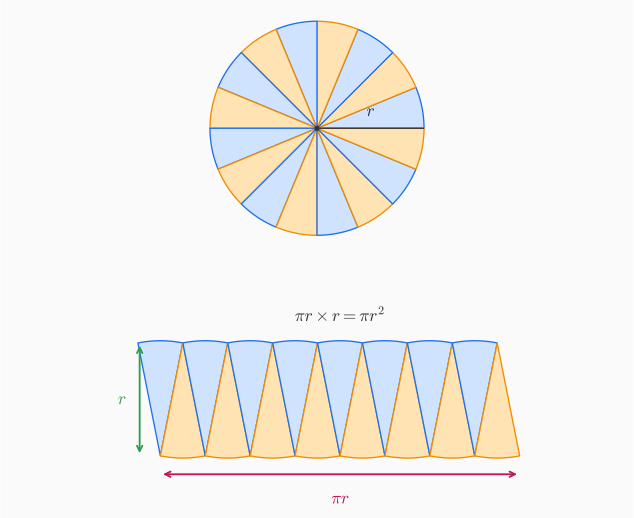
The base of this parallelogram is close to half the circumference $C = 2\pi r$, namely $\pi r$ (the top and bottom edges split the circumference in half). The height is close to the radius $r$. Hence
$$\text{area} \approx (\text{base}) \times (\text{height}) = \pi r \times r = \pi r^2.$$
The finer the cut, the less the scalloped edges matter, and the closer the shape gets to a parallelogram. In the limit the area is exactly $\pi r^2$.
This is an easy-to-follow explanation, but note that a limit has already crept into the words "approaches" and "in the limit." The next section makes this limit precise in the ancient Greek manner.
4. Archimedes' method of exhaustion (rigorous, no integration)
Archimedes, Measurement of a Circle, Proposition 1
The area of a circle equals the area of a right triangle whose legs are the radius $r$ and the circumference $C$:
$$\text{(area of the circle)} = \tfrac{1}{2}\,r\,C = \tfrac{1}{2}\,r\,(2\pi r) = \pi r^2.$$
The tools of the proof are the regular $m$-gon inscribed in the circle and the regular $m$-gon circumscribed about it. As $m$ grows, the two squeeze the circle from inside and outside.
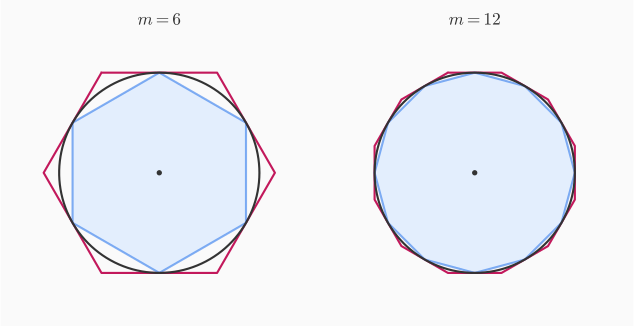
The area of a regular $m$-gon can be written using the distance from the center to a side (the apothem $a$) and the perimeter $p$:
$$\text{(area of a regular polygon)} = \tfrac{1}{2}\,a\,p$$
(split it into $m$ isosceles triangles from the center to each side and add up $\tfrac12 \times (\text{base}) \times (\text{height})$; no limit is needed here). Here $a$ is the length of the perpendicular dropped from the center $O$ to a side (the apothem), as shown below.
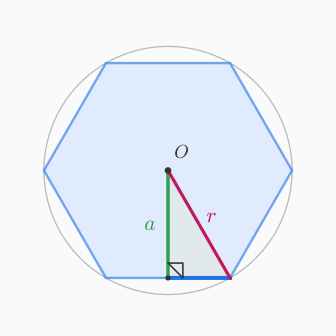
As $m$ grows large:
- Inscribed polygon: apothem $a \to r$, perimeter $p \to C$. Its area rises toward $\tfrac12 rC$ from below.
- Circumscribed polygon: apothem $a = r$ (the sides touch the circle), perimeter $p \to C$. Its area falls toward $\tfrac12 rC$ from above.
Double reductio ad absurdum (the heart of exhaustion)
Let the circle's area be $A$ and the target be $T=\tfrac12 rC$.
- Suppose $A > T$. By taking a fine enough inscribed polygon we can make the circle-minus-polygon difference less than $A-T$, producing an inscribed polygon of area exceeding $T$. But an inscribed polygon always has area $\tfrac12 a p < \tfrac12 rC = T$ — a contradiction.
- Suppose $A < T$. Similarly we can make a circumscribed polygon's area less than $T$, but a circumscribed polygon always has area $\tfrac12 rp > \tfrac12 rC = T$ (since $p>C$) — a contradiction.
Since both inequalities are impossible, $A = T = \tfrac12 rC = \pi r^2$. $\blacksquare$
This argument uses no integration whatsoever — Archimedes did it roughly $2000$ years before calculus. Yet its essence is the single fact that the area difference between the polygons and the circle can be made as small as we like, which is precisely exhaustion, i.e. a limit.
5. Why a limit cannot be avoided
"Integration was avoided. But can the limit itself be avoided?" The answer is no. Here is the reason, layer by layer.
(a) A limit is built into the very definition of area
The area of a region bounded by a curve can only be defined by approximating it with polygons from inside and outside and taking the supremum (infimum). So a limit enters at the level of the definition, in the form of the completeness of the real numbers (the existence of a supremum).
(b) Finite cut-and-paste does not reach it
For polygons, any two of equal area can be transferred into one another by cutting them into finitely many pieces and reassembling (the Bolyai–Gerwien theorem). No limit is needed here. But a circle is not a polygon, so this theorem does not apply.
Going deeper: why finite cut-and-paste is not enough (Tarski's circle-squaring problem)
"Can a circle be cut into finitely many pieces and rearranged into a square of the same area?" is known as Tarski's circle-squaring problem (1925). Miklós Laczkovich (1990) proved that it is possible. However, the pieces are non-measurable sets (relying on the axiom of choice), the construction is neither elementary nor constructive nor by straightedge and compass, and it does not deliver the value $\pi r^2$. This is a deep reason why finite, elementary cut-and-paste alone cannot reach $\pi r^2$.
Conclusion. Proportionality to $r^2$ follows with no limit from similarity alone. But pinning down the constant $\pi$ and defining the area both require a limit (exhaustion, the completeness of the reals). What can be avoided is integration, not the limit.
Summary
- That the area is proportional to the square of the radius ($=k r^2$) follows from similarity alone, with no limit.
- That the constant $k$ equals the number $\pi$ is shown by Archimedes' method of exhaustion: area $=\tfrac12 rC = \pi r^2$.
- Rearranging sectors into a parallelogram (base $\pi r$, height $r$) gives the visual picture of this result.
- The proof uses no integration, but a limit (exhaustion) is essential.
- That the $\pi$ of the circumference and the $\pi$ of the area are the same constant is established at the same time.
In short, what has been proved is the single chain of equalities
$$\text{area of the circle} = \tfrac{1}{2}\,r\,C = \tfrac{1}{2}\,r\,(2\pi r) = \pi r^2.$$
Frequently asked questions
Q1. Why is the area of a circle $\pi r^2$?
If you cut a circle into thin sectors and lay them out alternately, they approach a parallelogram whose base is half the circumference, $\pi r$, and whose height is the radius $r$. Hence the area is $\pi r\cdot r = \pi r^2$. Rigorously, squeezing the circle between inscribed and circumscribed regular polygons and making their area difference as small as we like (the method of exhaustion) shows that the circle's area equals the area of a right triangle with legs $r$ and the circumference, namely $\tfrac12 r\cdot 2\pi r = \pi r^2$.
Q2. Can it be proved without integration?
Yes. Archimedes found the area of a circle roughly $2000$ years before calculus, using the method of exhaustion with inscribed and circumscribed polygons. No integration is needed. However, this argument treats area as a limit (the supremum of polygonal approximations), so the limit itself cannot be avoided.
Q3. Can it be proved without any limit at all?
No. That the area is proportional to the square of the radius ($=k r^2$) follows from similarity alone, but pinning the constant $k$ to the number $\pi$, and even defining the area of a region bounded by a curve, both require exhaustion, i.e. a limit (the completeness of the real numbers). Two polygons of equal area can be transferred by finite cut-and-paste (the Bolyai–Gerwien theorem), but a circle is not a polygon, so that does not apply.
Q4. Why is the $\pi$ in the circumference the same as the $\pi$ in the area?
The number $\pi$ is defined as the ratio of circumference $C$ to diameter, $C=2\pi r$. Substituting $C=2\pi r$ into Archimedes' result "area $=\tfrac12 r\cdot C$" gives area $=\pi r^2$, which shows that the $\pi$ appearing in the circumference and the $\pi$ appearing in the area are the same constant. This coincidence is not obvious and is one of the crucial points of the proof.
Related topics and references
Related pages on this site
- Circle (equation of a circle) — the circle in the coordinate plane
- Circular sector — area $\tfrac12 r^2\theta$ and arc length $r\theta$
- Regular polygon — apothem and area $\tfrac12 ap$; the approximating figures used in exhaustion
- Annulus — the area between two concentric circles
References
- Wikipedia: Area of a circle
- Wikipedia: Method of exhaustion
- Wikipedia: Tarski's circle-squaring problem