Heron's Formula
Area of a Triangle from Its Three Sides
Introduction
Let $a, b, c$ denote the side lengths of a triangle $ABC$ opposite to vertices $A, B, C$ respectively. Define the semiperimeter $s$ as
$$s = \dfrac{a+b+c}{2} \tag{1}$$Then the area $S$ of triangle $ABC$ is given by
Heron's Formula
$$S = \sqrt{s(s-a)(s-b)(s-c)} \tag{2}$$This formula computes the area from the three side lengths alone, making it extremely useful when coordinates or angles are unknown. It was presented by Heron of Alexandria in his work Metrica in the 1st century AD.
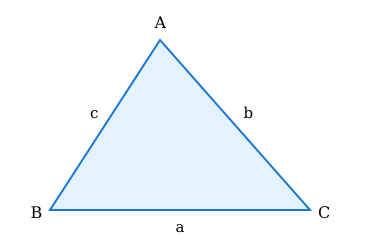
Proof 1: Algebraic Proof Using the Law of Cosines
Drop a perpendicular of length $h$ from $A$ to side $BC$ (Figure 2). Since the area of a triangle equals base times height divided by 2 (proof),
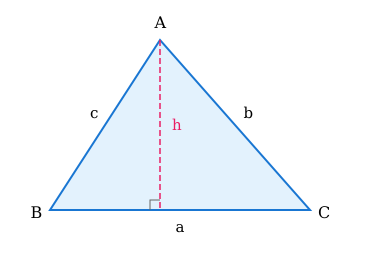
we can write
$$S = \dfrac{ah}{2} \tag{3}$$The altitude $h$ can be expressed using the angle $C$:
\begin{align} h &= b \sin C \tag{4} \\ &= b \sqrt{1 - \cos^2 C} \tag{5} \\ &= b \sqrt{(1+\cos C)(1-\cos C)} \tag{6} \end{align}where we used $\sin C > 0$ since $0 < C < \pi$. The law of cosines gives
$$c^2 = a^2 + b^2 - 2ab\cos C \tag{7}$$so that
$$\cos C = \dfrac{a^2 + b^2 - c^2}{2ab} \tag{8}$$Substituting (8) into (6),
\begin{align} h &= b \sqrt{\left(1 + \dfrac{a^2+b^2-c^2}{2ab}\right)\left(1 - \dfrac{a^2+b^2-c^2}{2ab}\right)} \\ &= b \sqrt{\dfrac{a^2+2ab+b^2-c^2}{2ab} \cdot \dfrac{-(a^2-2ab+b^2-c^2)}{2ab}} \\ &= \dfrac{1}{2a}\sqrt{-\{(a+b)^2-c^2\}\{(a-b)^2-c^2\}} \tag{9} \end{align}Substituting (9) into (3),
\begin{align} S &= \dfrac{a}{2} \cdot \dfrac{1}{2a}\sqrt{-\{(a+b)^2-c^2\}\{(a-b)^2-c^2\}} \\ &= \dfrac{1}{4}\sqrt{-\{(a+b)+c\}\{(a+b)-c\}\{(a-b)+c\}\{(a-b)-c\}} \\ &= \dfrac{1}{4}\sqrt{(a+b+c)(-a+b+c)(a-b+c)(a+b-c)} \tag{10} \end{align}In the last step we reordered the factors and absorbed the minus sign into $(a-b-c)$. Using $s = (a+b+c)/2$ from (1),
\begin{align} S &= \dfrac{1}{4}\sqrt{2s \cdot 2(s-a) \cdot 2(s-b) \cdot 2(s-c)} \\ &= \dfrac{1}{4}\sqrt{16\,s(s-a)(s-b)(s-c)} \\ &= \sqrt{s(s-a)(s-b)(s-c)} \tag{11} \end{align}This is Heron's formula (2). $\blacksquare$
Proof 2: Visual Proof Using the Incircle
The following elegant proof, due to R. B. Nelsen (2001), illustrates each step with diagrams. It derives Heron's formula via two lemmas.
Lemma 1: $S = rs$
Let $I$ be the center and $r$ the radius of the incircle of the triangle (Figure 3). The angle bisectors from each vertex pass through $I$. Dropping perpendiculars from $I$ to each side partitions the triangle into six right triangles (Figure 4).
Since two tangent segments from an external point to a circle have equal length, the tangent lengths from each vertex are:
- From vertex $A$: $x$ (on both sides $AB$ and $CA$)
- From vertex $B$: $y$ (on both sides $AB$ and $BC$)
- From vertex $C$: $z$ (on both sides $BC$ and $CA$)
From the side lengths we obtain the system of equations:
$$\left\{\begin{aligned} y + z &= a & \text{...(i)} \\ z + x &= b & \text{...(ii)} \\ x + y &= c & \text{...(iii)} \end{aligned}\right.$$Adding (i)+(ii)+(iii) gives $2(x+y+z) = a+b+c = 2s$, so
$$x+y+z = s \tag{iv}$$Subtracting (i), (ii), (iii) from (iv) respectively,
\begin{align} x &= \underbrace{(x+y+z)}_{s} - \underbrace{(y+z)}_{a} = s - a \\ y &= \underbrace{(x+y+z)}_{s} - \underbrace{(z+x)}_{b} = s - b \\ z &= \underbrace{(x+y+z)}_{s} - \underbrace{(x+y)}_{c} = s - c \end{align}That is,
$$x = s - a,\quad y = s - b,\quad z = s - c \tag{12}$$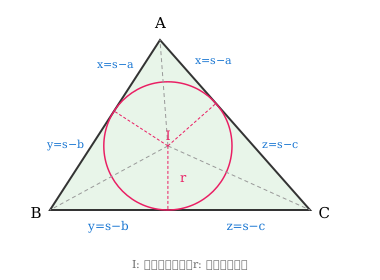
The six right triangles form three congruent pairs with legs $(r, x), (r, x), (r, y), (r, y), (r, z), (r, z)$.
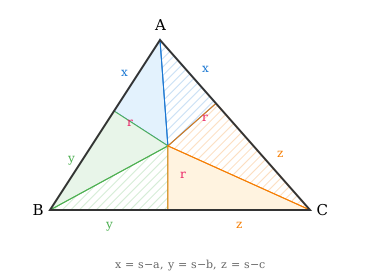
Rearranging these six right triangles, they tile a rectangle of height $r$ and width $x + y + z = s$ (Figure 5).
$$S = r(x + y + z) = rs \tag{13}$$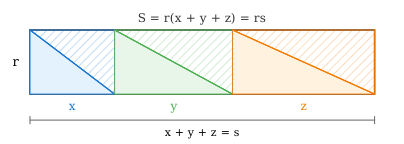
Lemma 2: $xyz = r^2 s$
In the six right triangles of Figure 4, let $\alpha, \beta, \gamma$ be the half-angles at each vertex created by the angle bisectors. Since the interior angles of a triangle sum to $\pi$,
$$\alpha + \beta + \gamma = \dfrac{\pi}{2} \tag{14}$$From each right triangle (Figure 6),
$$\tan\alpha = \dfrac{r}{x},\quad \tan\beta = \dfrac{r}{y},\quad \tan\gamma = \dfrac{r}{z} \tag{15}$$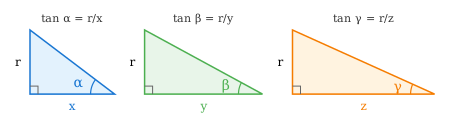
We now prove the following identity for positive angles satisfying (14):
$$\tan\alpha\tan\beta + \tan\beta\tan\gamma + \tan\gamma\tan\alpha = 1 \tag{16}$$Proof of (16): From (14), $\gamma = \dfrac{\pi}{2} - (\alpha + \beta)$. The complementary angle relation $\tan(\pi/2 - \theta) = 1/\tan\theta$ gives
$$\tan\gamma = \dfrac{1}{\tan(\alpha+\beta)} \tag{17a}$$Applying the addition formula $\tan(\alpha+\beta) = \dfrac{\tan\alpha+\tan\beta}{1-\tan\alpha\tan\beta}$ and taking the reciprocal,
$$\tan\gamma = \dfrac{1-\tan\alpha\tan\beta}{\tan\alpha+\tan\beta} \tag{17b}$$Substituting into the left-hand side of (16),
\begin{align} &\tan\alpha\tan\beta + (\tan\alpha+\tan\beta)\tan\gamma \\ &= \tan\alpha\tan\beta + (\tan\alpha+\tan\beta)\cdot\dfrac{1-\tan\alpha\tan\beta}{\tan\alpha+\tan\beta} \\ &= \tan\alpha\tan\beta + (1-\tan\alpha\tan\beta) = 1 \quad\blacksquare \end{align}Substituting (15) into (16),
$$\dfrac{r^2}{xy} + \dfrac{r^2}{yz} + \dfrac{r^2}{zx} = 1 \quad\Longrightarrow\quad \dfrac{r^2(x+y+z)}{xyz} = 1$$Since $x + y + z = (s-a)+(s-b)+(s-c) = s$,
$$xyz = r^2 s \tag{18}$$Main Proof
Squaring Lemma 1 ($S = rs$) gives $S^2 = r^2 s^2$. Substituting Lemma 2 ($xyz = r^2 s$),
$$S^2 = r^2 s \cdot s = xyz \cdot s = s(s-a)(s-b)(s-c) \tag{19}$$Therefore $S = \sqrt{s(s-a)(s-b)(s-c)}$, completing the proof of Heron's formula. $\blacksquare$
Worked Example
Consider the right triangle with $a = 5,\ b = 4,\ c = 3$ (Figure 8).
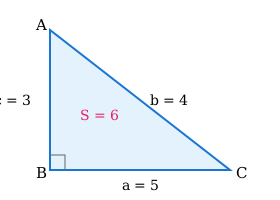
The semiperimeter is
$$s = \dfrac{5+4+3}{2} = 6$$Applying Heron's formula,
\begin{align} S &= \sqrt{6(6-5)(6-4)(6-3)} \\ &= \sqrt{6 \cdot 1 \cdot 2 \cdot 3} = \sqrt{36} = 6 \end{align}This agrees with base $4 \times$ height $3 \div 2 = 6$.
References
- Heron's formula — Wikipedia
- R. B. Nelsen, "Heron's Formula via Proofs Without Words," The College Mathematics Journal, Vol. 32, No. 4 (2001), pp. 290–292. [JSTOR]
- ヘロンの公式 — Wikipedia (日本語)
Frequently Asked Questions
Q1: What is Heron's formula?
A: Heron's formula computes the area $S$ of a triangle from its three side lengths $a,\,b,\,c$ alone. Using the semiperimeter $s = \dfrac{a+b+c}{2}$, the area is $S = \sqrt{s(s-a)(s-b)(s-c)}$. It is widely used in surveying and computer graphics because it requires no coordinate or angle information.
Q2: What are the main proof methods for Heron's formula?
A: Two representative proofs are: (1) an algebraic proof using the law of cosines, starting from $S = \dfrac{1}{2}ah$ with $h = b\sin C$, then eliminating $\cos C$ and factoring; (2) a visual proof using the incircle (Nelsen, 2001), combining $S = rs$ with the tangent identity $\tan\alpha\tan\beta + \tan\beta\tan\gamma + \tan\gamma\tan\alpha = 1$, where each step is illustrated with diagrams.
Q3: Who discovered Heron's formula?
A: The formula was published by Heron of Alexandria, a 1st-century mathematician, in his work Metrica. However, it has been suggested that Archimedes may have known the formula earlier.